The Story of Euis Maryati: Widowed and Planting Trees to Support Her Family
Euis Maryati
Euis Maryati: Widowed and Planting Trees to Support Her Family
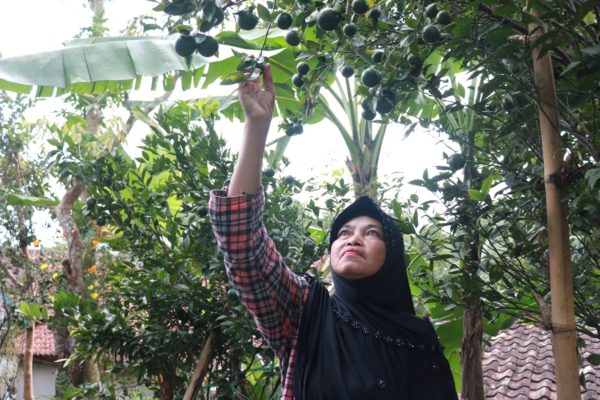
For a woman with four children, it is never easy being a single parent. This is how Euis Maryati (57) feels. She is one of the farmers in Patrolsari Village, Arjasari District. Since a few years ago, she had to be a mother and also head of the family.

As a widower, her life is struggling. Even though, she keeps herself motivated to be a strong woman for the sake of her family. Unlike common life of most women in her village, her daily life is not only about taking care of the household things, but also making income to fulfill her family’s needs. Otherwise, she has to work harder than anyone else. 

Farming Crops is not Enough to Fulfill Her Family’s Daily Needs

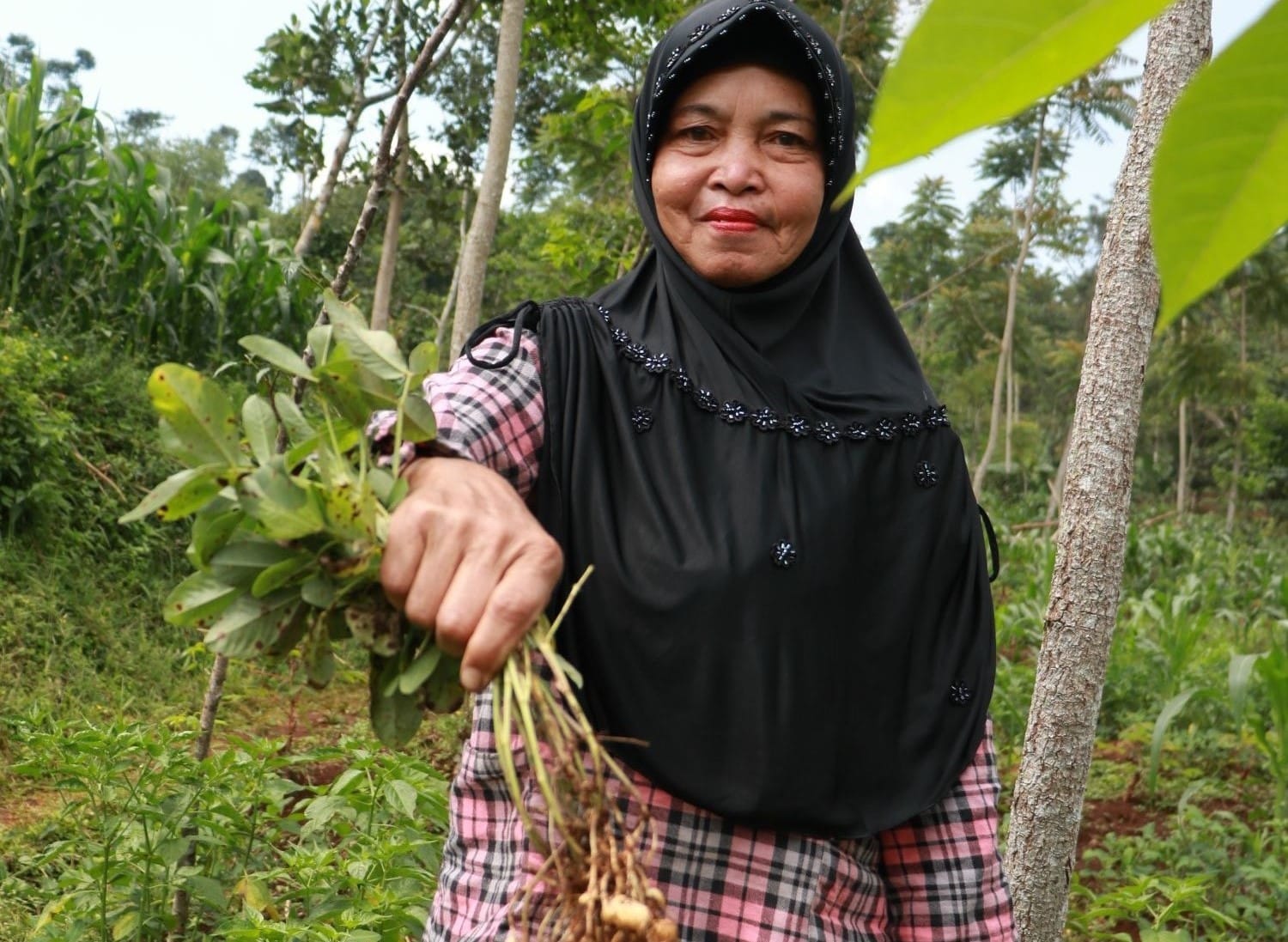
Fortunately, Euis Maryati has a field that she can plant many kinds of plants. Most of them are seasonal food crops. Through her field, she can depend her life to the crops’ yield. “Here, I planted various kind of food crops. I planted chilies, cassava, ground nuts, and red bean. There is also corn. Usually, I harvest my seasonal crops once in every two to three months,” said Euis Maryati.  

Afterwards, she sells her crops in a traditional market around her village. Some of the crops are also self-consumed by her family. According to Euis Maryati, by planting crops, at least she does not have to worry if some days she does not have enough money to buy food. Still, she can pick some food crops from her field for her own family consumption.  
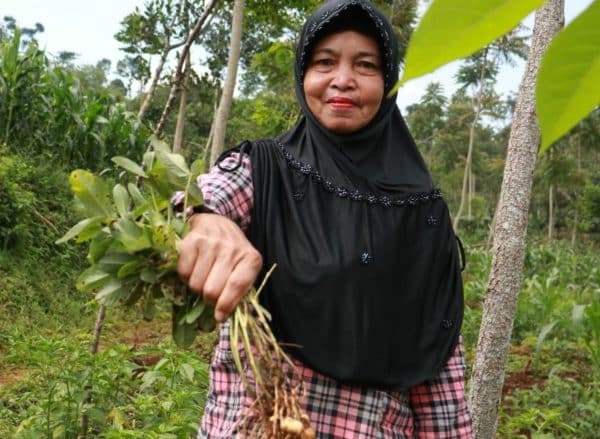
Euis Maryati: Widowed and Planting Trees to Support Her Family
Euis Maryati has harvested crops from her field. Photo: Trees4Trees/Kemas Duga Muis

Even though, to meet her family’s daily needs, she cannot avoid doing double jobs at one time. Besides farming, she also sells snacks. “If I do not farm, I cannot support my family’s needs. However, farming crops is not enough. So, I have also opened a small business selling snacks. It is to increase my income to meet my family’s daily needs,” she conveyed. 

Planting Trees: Cultivating a Better Future for Her Family

In 2021, when she was offered a partnership program of tree planting funded by Astra Zeneca collaborated with Trees4Trees and One Tree Planted, Euis Maryati planted burflower-tree, avocado, mango, and orange. She planted those trees among her seasonal crops in her field. She admitted that she was lucky to get plants from the tree planting program. She hopes a lot from trees she planted for the future of her family. 

She has been persevering in taking care of her trees. She cleans the grass every day so that all the plants grow well. She also applies her plants with organic fertilizer that she made herself from animal dung. 
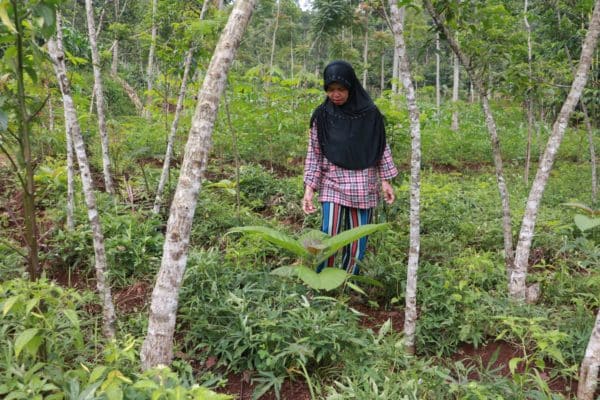
Euis Maryati: Widowed and Planting Trees to Support Her Family
Euis Maryati is checking her jabon trees planted in her field along with various crops.

She expects, by taking good care of those trees, she will be able to harvest the good results. Moreover, now plants in her field are more varied. With more types of trees planted, she hopes she can sell more yields in the future, then she can fulfil her family’s needs much better than today. 

“My life has been difficult for years. So I am hoping that it does not get any harder. If not myself, who else will  support my family? I realize that I am both the mother and the head of the family. It is not easy. But for my children and their future, I will continue to work harder,” she stated.  

She thanks to the tree planting program and she hopes it can bring more prosperity and a better future for women farmers and single parents like her. 
 

Replanting Mangroves, Rebuilding Futures in Central Java

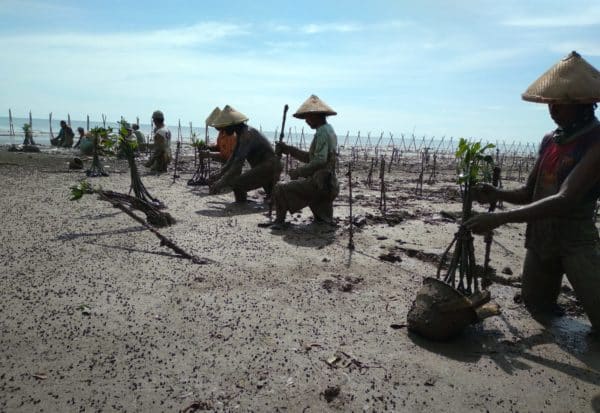
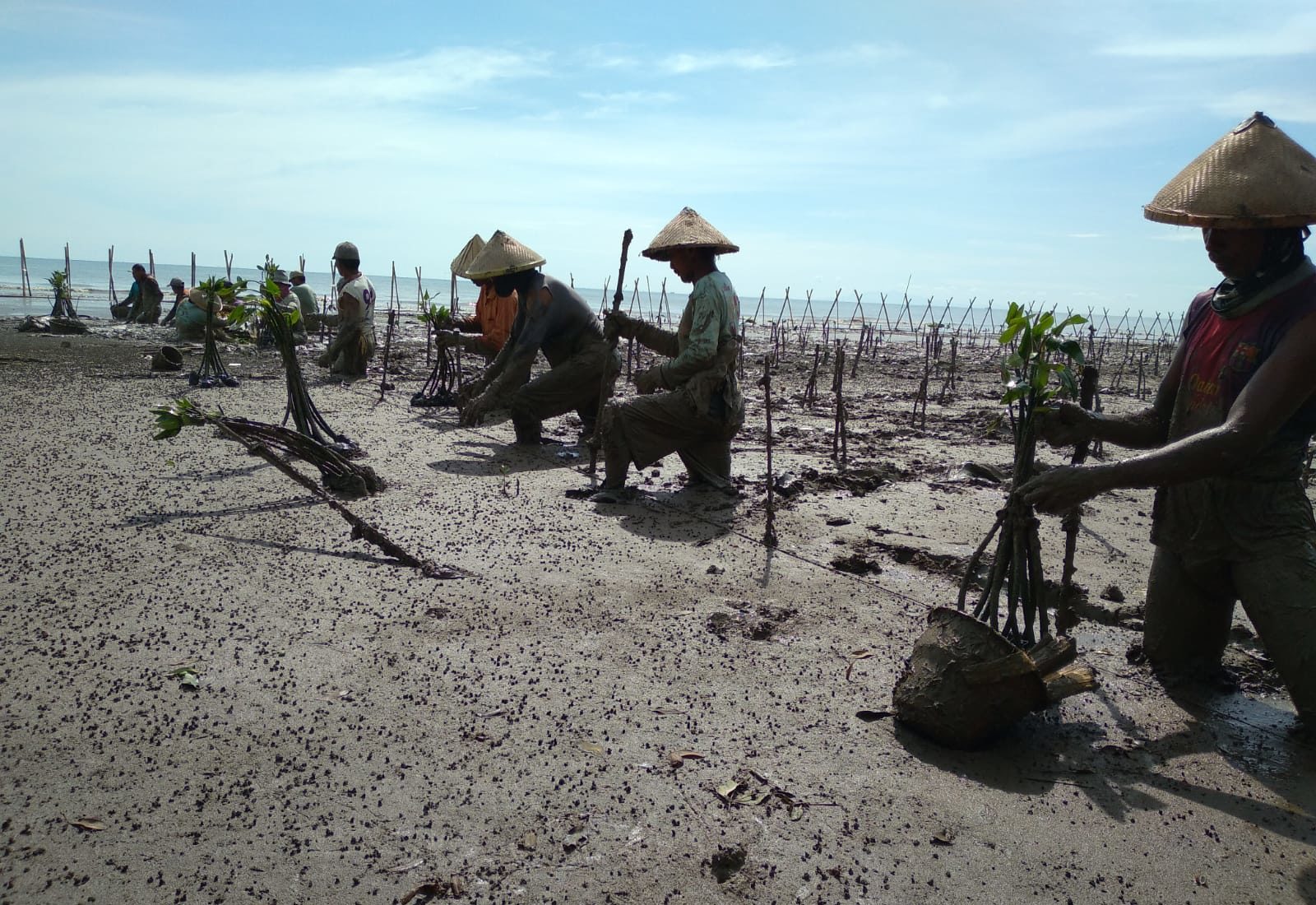
Trees4Trees has been working with local communities to replant mangroves in Central Java
Trees4Trees has been working with local communities to replant mangroves in Central Java. Photo: Doc. Trees4Trees

On New Year’s Eve, Pati Regency in Central Java was inundated by heavy rains. This caused flooding that destroyed more than 600 hectares of agricultural land and damaged thousands of homes. But there was one silver lining to the black clouds that surrounded Pati in December – residents noticed that the areas least affected by the floods were also places with the highest coverage of mangrove forests.  

From the wreckage came the green shoots of a solution. Now, with support from local government and outside help from investors like EcoMatcher, Trees4Trees is working with communities in Pati to restore mangrove forests and rebuild for the future.  

Read also: Mangrove Planting Program with EcoMatcher Inspires Villagers to Plant More Mangrove Trees

A Rising Tide: Building Awareness of Mangroves 

“In recent years, local people’s awareness of mangroves has increased,” says Fauzan Timurlang, who is the Trees4Trees Unit Manager in Pati. He believes the benefits provided by mangroves have become clearer since the recent floods, with many people ready to take action. “They have seen that mangroves can act as barriers that break the waves and reduce the damaging impact,” he explains.  

Andi Lestari is a mangrove activist in Pati, working alongside Trees4Trees. He too has noticed an increase in community awareness. “Many people have seen for themselves the great benefits of mangroves,” he explains. “They have seen that areas with mangrove cover suffer less damage compared to areas that did not have any,” he added. 

Read also: The Incredible Benefits of Mangroves Ecosystem  

Root and Branch: Combining Community Action with Government Support 

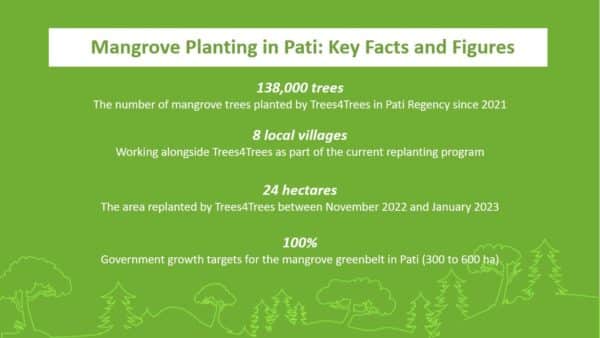
Pati Regency stretches 37 miles (60 km) along the coastline of Central Java. Officials here have decided to double mangrove coverage from 300 to 600 hectares, effectively creating a natural barrier that can prevent coastal erosion and protect local homes and livelihoods from flooding. 

“We want to create a green belt from Pencangaan to Puncel,” explains Edy Martanto, Head of the Maritime Affairs and Fisheries Service (DKP) for Pati, in a recent interview with Muria News. “The green belt will function like a beach embankment – if there are waves, the mangroves will form a barrier – when the mangroves are strong, the ponds are also safe.”  

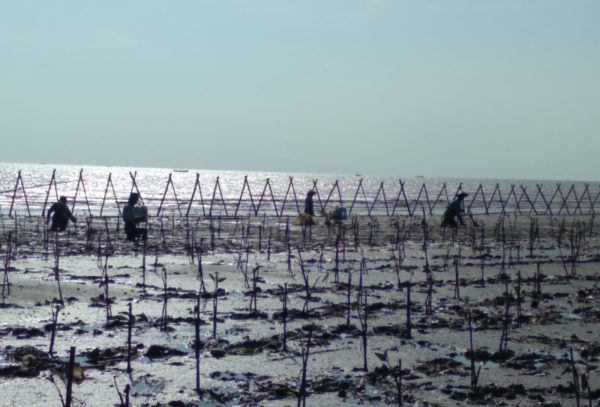
(Above) In areas like Kalikalong village in Pati Regency, Trees4Trees has been working to double mangrove cover

Planning into Planting: Trees4Trees Takes Action in Pati 

To help bring this green belt to fruition, Trees4Trees began planting mangroves along the Pati coastline from November 2022 to January 2023, as part of the recent planting season. By employing members of the community from eight local villages, Trees4Trees has already planted a total of 108,000 mangrove trees in an area covering 24 hectares.  

These seedlings (consisting of Red Mangrove or Rhizophora mucronata and White Mangrove or Avicennia marina), are endemic to the area, so will help replenish wild populations. They are currently being monitored to ensure they stay healthy and continue to grow. Back in 2021, and with support from EcoMatcher, Trees4Trees also planted around 30,000 mangrove seedlings across 3.8 hectares surrounding Dukuhseti village.

Read also: Mangrove Types in Indonesia and Their Benefits


Trees4Trees has planted more than 138,000 mangrove trees in Pati since 2021.

“The thicker the mangrove cover, the safer our fishponds will be – that’s why we’re so keen to be a part of the Trees4Trees mangrove planting program.”  Musthofa, Tani Makmur farmers’ group 


Local Communities on the Frontline of Mangrove Restoration 

To ensure mangrove restoration takes root in Pati, Trees4Trees has also involved local village officers and members of the forestry service. Six groups of local fishpond farmers have also been employed as mangrove planters.  

“Farmers in our group have become aware of the benefits provided by healthy mangrove ecosystems,” explains Musthofa, leader of the Tani Makmur farmer group. “The thicker the mangrove cover, the safer our fishponds will be; that’s why we’re so keen to be a part of the Trees4Trees mangrove planting program,” he added. 

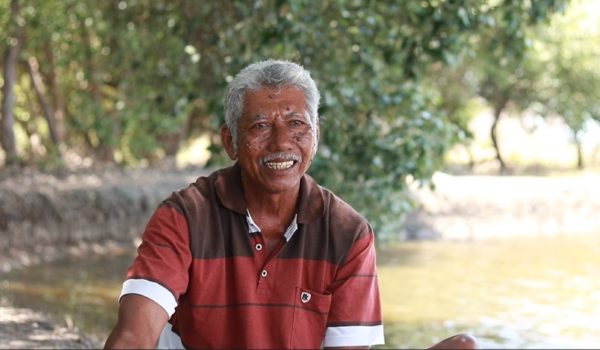
(Above) Parmi is one of many fishpond farmers joining in the Trees4Trees planting program in Dukuhseti village

Another of the fishpond farmers who joined the mangrove planting program is Parmi. Like many people here, he makes a living by farming fish and shrimp. With support from Trees4Trees, he is looking forward to a safer and more prosperous future. 

“Thick mangrove cover helps to protect our fishponds from strong waves, resulting in a higher abundance of fish,” explains Parmi. “I hope the mangroves we plant now will grow into a full forest like before, so they can continue to provide benefits for us and future generations.”  

Trees4Trees™ is a non-profit foundation focused on renewing the environment and empowering local communities through reforestation and education. For more information about the work we do, and to make a donation in planting mangroves, please go to devtrees4trees.portopaper.com. 

Writer: V.Arnila Wulandani. Editor: Christopher Alexander.

Rasito, Optimizing His Field with Coffee Trees

Rasito were proud of the sengon trees he grows. They reach more than 10-meters in height now.

In 2019, Rasito (53) joined the tree planting program initiated by Trees4Trees and Tree Ltd. At that time, he proposed various types of tree seedlings such as sengon, indigofera, and coffee to be planted in his field. He cannot help but feel grateful for the free seedlings he received. His decision to register and join the tree planting program three years ago was actually because of his strong will to optimize the yield of the field he owned. 

Fortunately, Rasito has a more fertile field compared to the fields in other villages. His field is located not far from his home in Kalirejo Village, Kebumen Regency.    

“I can say my field is fertile and easy to plant with any kind of crops and timbers. I think it is because the location is near the spring and river. So, when the dry season comes, it does not ever experience a drought,” Rasito said.  

Manage Pests is the Biggest Challenge

While strolling around his field, he seemed to trim the yellow leaves occasionally. According to Rasito, the biggest challenge to manage plants in his field is because of pests. “These yellow pests are very troublesome. They make leaves turn yellow, wilt, then die. Many sengon trees from Trees4Trees that I planted here were attacked by this kind of pest and could not survive. Auspiciously, there are still around 20 sengon trees that survive and grow well,” Rasito continued. He was pointing us to the sengon trees which now have reached 10 meters in height.  

Rasito, Optimizing His Field with Coffee Trees
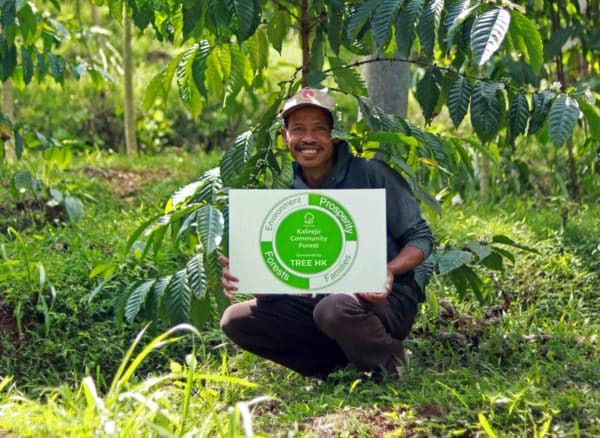
Rasito thanks Trees4Trees and Tree HK for providing him various kinds of tree seedling, including coffee.

Since returning to his village twenty years ago, Rasito has chosen to focus on agriculture. He used to work in the coffee plantation in Lampung, Sumatera. However, he decided to return to his village because his heart felt heavy to leave his 7-years old son at that time. 

From the coffee plantation he used to work at previously, he has learnt a lot about agriculture and how to grow coffee. From his parents, he inherited traditional agriculture knowledge. He used them to manage his field area of more than 1.000 square meters until now.  

Unsatisfied with The Result of His Field

Before joining the tree planting program, most of his field was planted with cassava and taro. There were also turmeric and Kaempferia galanga or aromatic ginger. He also planted stinky beans, papaya, and kelor trees. All the yields to be sold as his income to support his family’s daily needs. He also raised goats as his saving.  

Regrettably, the price of cassava as his main yield is less competitive in the market. “One kilogram of cassava that has been cleaned costs around 1.700 rupiahs. If I don’t clean the skin, the price is only 1.500 rupiahs per kilogram. Taro’s price is much better. It is more stable, around 2.000 rupiahs per kilogram,” Rasito revealed. When the price drops or does not sell well in the market, then Rasito must give up the cassava he grew to be used as his cattle’s feed.  

For that reason, when he heard that there was a tree planting program and free seedlings distribution, he was enthusiastic. “At that time, I heard that coffee seedlings would be distributed to farmers. I was interested. I always want to apply the knowledge I have learned from the coffee plantation where once I worked in my own field,” told Rasito. 

Rasito, Optimizing His Field with Coffee Trees
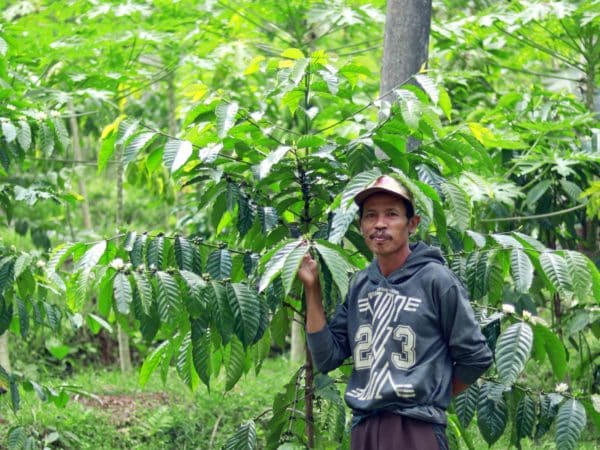
Rasito with Robusta coffee trees that he has grown since 2019.

Growing Coffee Trees, Increasing His Field’s Productivity

He was thrilled to know that of the 180 Robusta coffee seedlings he received in 2019, he managed to grow well 150 coffee trees. Over the last three years, he has already harvested twice. “In one harvesting time, there may be about 5 kilograms. But it has not been sold yet. I am still testing my coffee trees, grinding the beans, and consuming them by myself. I have compared the taste with the Robusta coffee sold in the market and even with coffee sold in a cafe. I am sure that this coffee can compete with them,” he said confidently.  

Compared with cassava, Rasito believes coffee is more prospective. He also said it is not difficult to grow coffee trees. According to his survey, ground Robusta coffee’s price in the market can reach 30.000 rupiahs per kilogram. That interested him. Therefore, Rasito intends to replace cassava and taro with coffee in the future. “These cassavas are temporary. When I can grow more coffee trees, I will replace all of cassava and taro with coffee in order to make my field more productive as well as my income,” he was hoping.  

In addition to coffee, Rasito also grows pepper which is planted as vines on other trees. He is quite satisfied with the result of pepper. He can sell them for 80,000 rupiahs per kilogram.  

Rasito expects he we will be allowed to join the next tree planting program with Trees4Trees. He hopes he can receive durian and avocado seedlings. “I have tried planting durian and it is growing well in my field. If there will be another program, I intend to apply durian seedlings as well as avocado,” said Rasito. 

The Story of Wasis: How A Tree Grower is Making a Difference in Water Conservation

Wasis, The Spring Warrior from Kalirejo Village
Photo: Trees4Trees/Yulianisa Dessenita

Wasis had never thought before that his decision to join the tree planting program initiated by Trees4Trees and Tree Ltd three years ago would be a blessing for many people around him. At the time, Wasis decided to join the tree planting program solely to expand his coffee field’s productivity. However, the trees he has grown not only provide him with a good result but also help preserve the water spring that provides clean water for his fellow villagers 

Wasis lives by himself in a hut not far from his field in Kalirejo Village, Kebumen Regency. There is a water spring established in his field and he is grateful for having it. Although it is little, the water spring is the only clean water source for his daily needs. He also believes the water spring is the key to his fertile field that never runs dry.

Water spring in Wasis’ field produce more clean water after he planted many coffee trees. Photo: Trees4Trees/Yulianisa Dessenita

Growing Coffee is Wasis’ Specialty 

Before returning to his home village eight years ago, Wasis had worked in coffee plantations in Sumatera for more than twenty years. Therefore, growing coffee has been his specialty for years. One day, he decided to come home and brought a few coffee seedlings to be planted in his own field. Although his field is not wide, he has managed it persistently since the beginning.  

Formerly, Wasis planted some timbers, a few coffee trees, and cassava in his field. Unfortunately, cassava did not grow well in his field. Then in 2019, when Wasis received around 200 Robusta coffee seedlings from the tree planting program conducted by Trees4Trees and Tree Ltd, soon, he replaced all cassava planted in his field with Robusta coffee trees he received.  

Harvesting Coffee, Making a Good Income  

After three years growing coffees, a few months ago finally he harvested them for the first time. Deciding to replace cassava with coffee trees was the best decision he ever made. “I got seven kilograms of Robusta coffee beans, and I sold them at Rp27.000 per kilogram,” he said proudly.   

Besides Robusta, Wasis also planted Arabica and Liberica coffee which he brought the seedlings from a plantation where he worked once. Wasis said the selling price of Liberica is higher than the other. “Liberica can reach Rp30.000 per kilogram,” he said.  

To make his coffee trees lush and fruitful, Wasis makes organic fertilizer from cow dung by himself. He believes that the organic fertilizer he applied causes his coffee trees to grow well and fruitful. “I get the cow dung from my neighbors who raise cows. I prefer cow dung better than goat dung because it makes my trees lusher,” he said.  

Coffee beans in Wasis’ field. Photo: Trees4Trees/V. Arnila Wulandani

Planting Trees, Preserving the Water Spring, Helping Local Residents

Wasis has been more than just proud of himself because the coffee trees he planted also made the water spring in his field produces more water than before. According to Wasis, now the spring not only can fulfill his clean water daily need but also other villagers’.  

“Around ten families in a neighboring village not far from here have been lacking clean water,” Wasis revealed. According to him, the local people have tried to dig wells but there was no water coming out. It has been very struggle for them to get clean water for a long time. When they heard the water spring in Wasis’ field has produced more water than before, they asked him permission to take water from there.  

“Water is the most essential thing in life, and they have had a hard time getting it for a long time. I cannot bear not to help them, so I allowed them to take water as much as they need from the spring in my field,” Wasis said.  

The Trees He Grows Bring Fortune 

Wasis said every neighbor who takes water from the spring, then they barter it with food crop yields or other essential things as a thank you.  

“They often barter it with rice grain in return. Usually, I get 50 kilograms of rice grains as a thank you,” Wasis told us. Some people also barter the water with vegetables or other food crops, making him does not need to buy groceries for his daily food. “The water is not only bartered with food. Sometimes, when I need cow dung to make organic fertilizer, they are willing to barter it with water,” he added.  

Wasis said he is so grateful because the spring can help many people and bring such fortune for him. “This spring is getting better because of trees from Trees4Trees and Tree Ltd that I have grown,” he said.  

Now, his biggest hope is to grow more and more trees, especially coffee trees. He wants to get good results to increase his income as well as to preserve the water spring that many people rely on to get clean water.