Mangroves Planting Program with EcoMatcher Inspires Villagers to Plant More Mangroves Trees

planting mangrove inspire more locals to plant more mangrove trees

planting mangrove in pati central java 

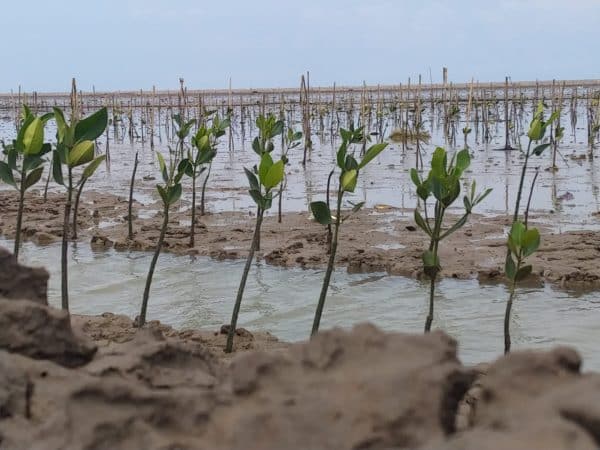
Pati Regency, located in northern Central Java, is one of the many mangrove-growing areas in Indonesia. This regency has approximately 8,000 hectares of potential mangrove areas. Nearly 25% of Pati’s total coastline was forested with mangroves. Unfortunately, the mangrove cover in this area is degraded and in poor condition.  In 2017, a survey in Pati showed that around 60% of mangrove cover had been lost in some districts.

Mangrove Cover in Poor Condition

Coastal erosion and land over-use are the most common causes of mangrove destruction in this area, making many mangrove areas become critical lands, including in Dukuhseti Village. Mangrove ecosystems play an important role in climate stabilization, coastal protection, biodiversity richness, local community’s economy, and supporting fishery.

Read also: Incredible Benefits of Mangrove Ecosystem

“In the past, our village had mangrove forests, but they were exposed to tremendous coastal erosion. After that, there was an expansion of the fishponds that cut down mangroves excessively. Consequently, now our village has no wave barriers around the coast,” said Mustofa, leader of the Tani Makmur farmer group in Dukuhseti Village.

Most of the villagers of Dukuhseti make their living as fish farmers and fishermen. They have fishponds near the coast. Their main products are tilapia and milkfish.

Mustofa said the most significant impact after the mangrove forest was drastically reduced is that now the village does not have any wave barriers, thus endangering small fishponds near the coast owned by local farmers.

“When the big waves come, our fishponds are often hit and destroyed by the waves. Big waves sometimes also bring runti pests (barnacles) in large numbers. They not only can injure fish farmers because they are sharp but also can infect young mangrove tree trunks,” Mustofa added.
planting mangroves in Pati Central Java

Planting Mangroves Program with Trees4Trees and EcoMatcher

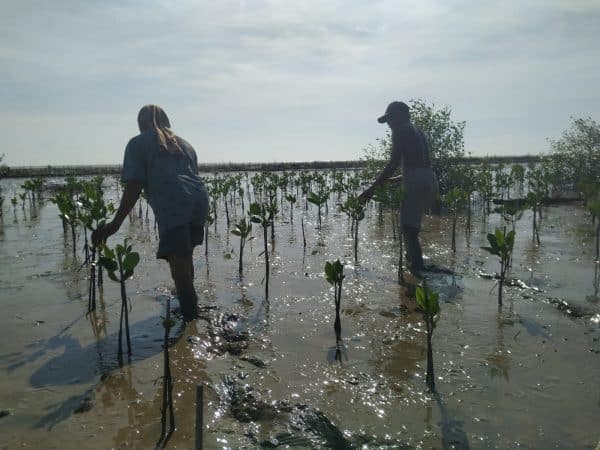
When Trees4Trees and EcoMatcher came to Dukuhseti Village and invited them to join the mangrove tree planting program, Mustofa and other members of the Tani Makmur group welcomed the project enthusiastically.

“The community was very supportive and excited when they knew the program was being implemented in our village. We hope that many mangrove trees can be planted so that erosion can be prevented, and our fishponds can be protected from waves,” said Mustofa. In addition, mangroves also benefit fishermen because they do not have to go to sea far to catch fish. The fish become more abundant around mangroves.
planting mangroves in Pati Central Java

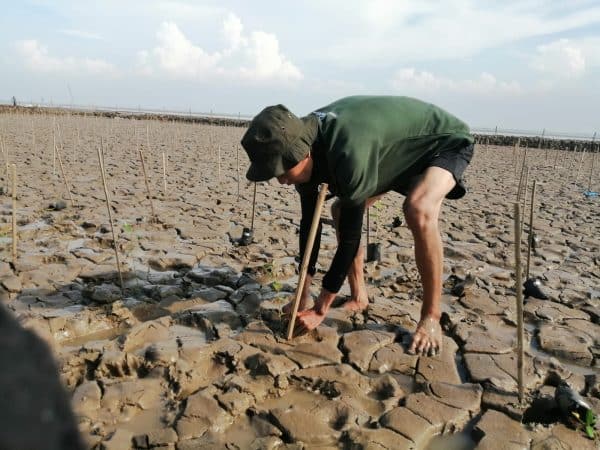
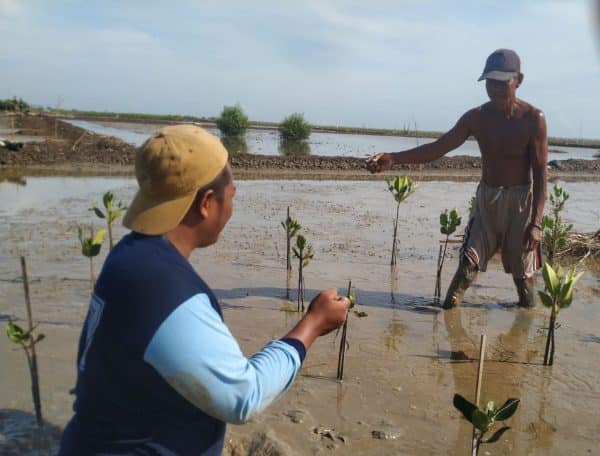
Since November 2021, Trees4Trees and EcoMatcher have planted 30,000 mangrove seedlings on the coast of Dukuhseti village in partnership with the fish farmers from the Tani Makmur farmer group. The mangroves planted covered an area of ​​3.8 hectares. The fish farmers are employed in producing seedlings, planting, and installing breakwater walls to protect the young seedlings.

“Before planting mangroves, the land was considered by the government to be critically degraded land. There were only a few mangrove trees left. We planted Avicennia and Rhizophora mangrove species because these two types were the original natural forest. We hope to restore the mangrove cover in this area completely,” Fauzan, Unit Manager of Trees4Trees Pati, said.

Inspire Local People to Plant More Mangrove Trees

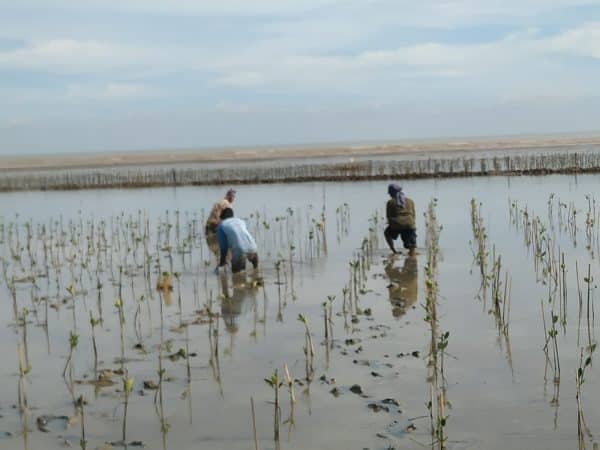
Interestingly, the Trees4Trees and EcoMatcher mangrove planting program also inspires and motivates locals to plant more mangrove trees around the village coast. Shortly after the planting project with Trees4Trees and EcoMatcher was completed, the villagers planted mangrove trees voluntarily around the planting area. They sow the Avicennia seedlings directly on the shore and around the fishponds while the waves are low.  
planting mangroves in Pati Central Java

“Actually, some villagers whose ponds are close to the coast had planted mangroves voluntarily a long time ago. However, this program motivates and inspires more people to plant more mangroves. We think it is because people are starting to realize the importance of mangroves’ existence in the village,” said Mustofa. The villagers thank Trees4Trees and EcoMatcher for the mangroves planting program. They also hope to plant more mangroves in the future.

This year, Trees4Trees has been partnering with EcoMatcher for five years, a moment to celebrate! Both are keen on their commitment to supporting local communities and environmental restoration by planting trees. Trees4Trees and EcoMatcher use technology to monitor the locations of the planted trees. Anyone can visit the trees they have planted through the EcoMatcher website.  Each tree planted by Trees4Trees and EcoMatcher is recorded with the TreeCorder application developed by EcoMatcher. With this technology, anyone can track and plant trees via a smartphone and get information about the trees and the farmers who care for them.

Author: V. Arnila Wulandani

The Incredible Benefits of Mangroves Ecosystem

world mangrove day

world mangrove day

When you walk along the beach, have you ever seen trees which grow in the seawater? Those are mangrove trees. They are a type of tree that can tolerate saltwater. Mangroves can be found along the shores, rivers, and coastlines in tropical and subtropical countries around the world.  

Indonesia itself is a home for one of the largest mangrove populations in the world. The mangrove cover in Indonesia is estimated to be 3,2 million hectares or 22,4 percent of the total mangroves’ population in the world. So, when you travel to Indonesia, mangroves can be found on almost every one of the 17,000 islands.  

The mangrove ecosystem is commemorated internationally on 26 July every year as the International Day for the Conservation of the Mangrove Ecosystem or World Mangrove Day. This day marks the importance of mangrove ecosystems for the wellbeing, food security, protection of coastal communities, and mitigating climate crisis.  

The ecosystem affords significant contributions for nature and human beings. It is not only incredibly effective in sequestering carbon, stabilizing climate, and combating climate crisis, but also supporting coastal communities’ livelihood and biodiversity.  

Here are some remarkable benefits of mangroves we need to know and why we should protect and restore this species.  

Mangroves are A Very Important Carbon Sink 

Compared with other terrestrial forests, mangroves absorb vast amounts of carbon. Mangrove forests can store five times more carbon than a typical tropical forest. One-hectare mangroves can store up to 3.700 tons of carbon, which is equivalent to taking more than 2.650 cars off the road for a year.  

Mangroves are effectively absorbing greenhouse gases from the atmosphere and mitigating the effects of climate change.  

Mitigate Coral Bleaching 

Coral bleaching is one of the devastating effects of climate change which causes coral to lose its color and turn white. When coral bleaching occurs, it disturbs the ocean ecosystem and can cause the death of entire coral reefs. Healthy mangrove forests can provide shelter for some coral species which are at risk. Mangrove forest also can reduce ocean acidification that can harm marine species such as mollusks, corals, and some varieties of plankton which are all important links in the worldwide food chain. 

Hotspot of Biodiversity and Nursery Ground 

Mangroves provide a home, nursery, and feeding ground for a wide range of animals, including fishes, birds, insects, reptiles, mammals, and various crustaceans like shrimps and crabs. Mangrove areas are also supplying organic and inorganic nutrients that are important for the species. In other words, mangroves are hotspots of biodiversity and form a healthy and rich ecosystem.  

Defense Against Floods, Waves, and Reduce Erosion 

Mangrove forests are effective in reducing strong wind and waves which pass through. They also act as a powerful coastal defense against storms, hurricanes, reducing the high waves and destructive tidal surge. The dense roots of mangroves are capable of binding and building soil which can slow down water flows and reduce erosion. 

Supporting Well-being and Livelihood for Coastal Communities 

Mangroves provide benefits for millions of people who live close to coastal areas with mangrove forests. Many of them rely on mangroves for food, wood, tourism, and enhance fishery productivity. 

Some mangroves’ species bear fruit which can be processed into flour, snacks, and other foods. Mangroves are also habitat for fishes and various crustaceans like shrimps and crabs which provide daily food and income for local communities.   

World mangrove day

Mangroves accommodate incredible benefits and impacts for nature and human beings. Sadly, mangroves have experienced loss and degradation worldwide, declining 30 to 50 percent in the past 50 years. In Indonesia mangrove forests are also in a significant level of degradation. About 52 thousand hectares of mangrove forests in Indonesia are lost every year.

Read also: Mangrove Planting Program with EcoMatcher Inspires Villagers to Plant More Mangrove Trees

In 2021, Trees4Trees planted 36.000 mangroves in 3.8-hectare mangrove as a pilot project in Pati, Central Java. In 2022 Trees4Trees will plant 100,000 more mangrove trees in this area. 

The loss of mangrove cover will bring serious negative impacts not only ecologically but also economically. Therefore, protecting and conserving mangrove ecosystems needs our collective efforts. You can also contribute to planting mangrove trees with us. Contact us to find out how to get involved! 

Happy International Day for the Conservation of the Mangrove Ecosystem! 

Author: V. Arnila Wulandani

Sarpin: Planting Trees Are More Important Than Money

Sarpin plants trees not because of money

Sarpin plants trees not because of money

Gunungsari village, Kebumen, Central Java, is famous for its waterfall tourist attraction and the lives of one of our farmers, Sarpin. He owns the land next to waterfalls. In the past, he was just a paddy farmer, but the land he owned was not suitable for that so he switched to planting fruit trees supported by our tree planting program, Trees4Trees. 

Sarpin is one of our best farmers, he joined our program since 2019. There is a reason why he became our best farmer, he’s not only planting regularly, but he also educates young farmers about agriculture and gives them life lessons. 

For him, planting is a joy and a necessity. He doesn’t care how much money he gets from planting. He believes that we will never run out our fortunes as long as we are always grateful. When we asked him why did he choose to be a farmer? he literally could sell his land for tourist attraction and live a prosperous life. But he explained that he was not looking for material happiness. 

”I’m not after money, but money chasing me”, he laughs.  

”It’s true… whoever sows he will reap. You plant a tree, you can eat the fruit, you sell the fruits, the leaves can be used as animal feed.” 

Money is not everything for Sarpin. Having a lot of money does not guarantee him a happy and peaceful life. By planting trees, he was able to support his daily needs and provide adequate education to his children. Even though sometimes he doesn’t get a daily income, he can get vegetables and fruits from the field to cook.  

Read also: Grandpa Wasis and His Dedication to Planting Coffee

So even there is a developing tourist attraction around his land, he will not sell his land and maybe he will just rent it out some of it for small stalls to help the local economy.  

Sarpin then told us about his son who had worked in Korea and returned to the village to continue farming. He is very proud of his son’s decision to choose to return to the village and take care of the land and be active in community activities. 

”The salary is big (in Korea), but he didn’t feel peaceful… that’s why he came back here”.  

”He missed his beautiful, he missed home cook and he missed his parents”. he added.  

Sarpin explained that the villagers of Gunungsari live a simple life and help each other. They support activities that prosper the village and the environment. They are very happy to be involved in planting programs.  

”We don’t ask for money or basic needs”, he explains. ”give us seedlings and we can survive’’. 

We relized,  that the general understanding of most people is that giving money to people in need is a shortcut to help. But actually, the wiser way to help is to teach them to be independent and a chance to try again, they need this kind of support.   

He reminded us to always be grateful and says: if you want to feel rich, plant a tree. If you want a peace, plant a tree.   

We really enjoyed our time with Sarpin and we are very grateful for his contributions and support for our tree planting program. We hope that we will meet him again next year to see his trees grow and to share more stories. 

Author: Yulianisa Dessenita


Grandpa Wasis And His Dedication to Planting Coffee


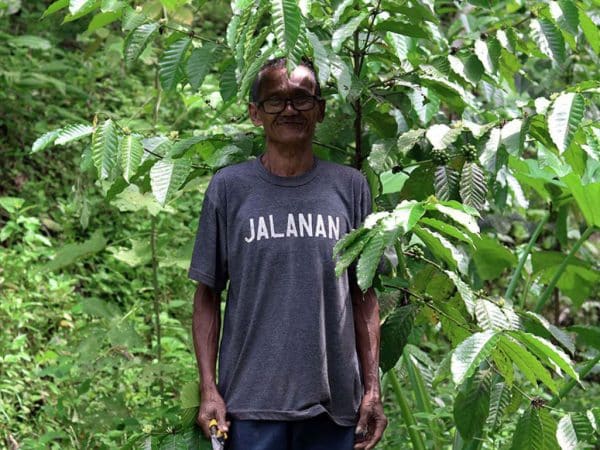
In a hamlet called Wonosari in Kalirejo Village, Kebumen – Central Java, there is a small hut far from the settlement, surrounded by coffee trees and there lives an old man named Grandpa Wasis. He lives alone in the hut, inside the hut there’s only one lamp and an old radio. Grandpa Wasis calls it home. Meanwhile, his wife chose to live with her eldest child in the neighboring village. 

That afternoon Grandpa Wasis was waiting for us in front of his house. He made time for us in the middle of his work. He is very friendly and always has a smile -maybe Grandpa Wasis hasn’t been visited by guests in a long time.  

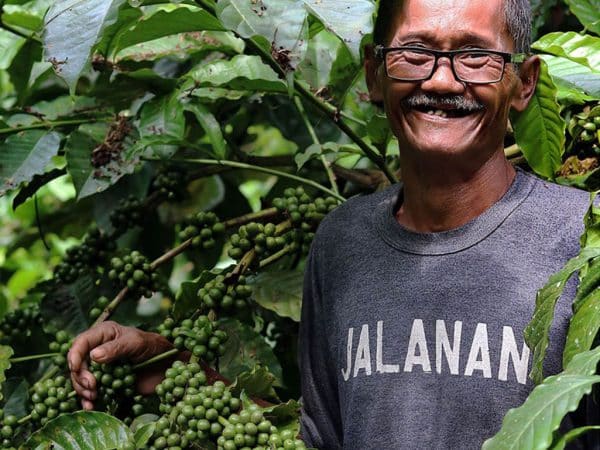
We were impressed with the coffee plantations that he takes care of, they are lush and fruitful. We asked him what is the secret of it? And he answered ”experience” with a little laugh. 

Grandpa Wasis explained that he does not have secret method but just follows the usual ways of taking care of his trees, only that he monitors his plants every day to make sure each tree gets the care it needs. That’s why he chose to stay on his land. 

He shared that he had planted coffee trees when he was very young. He has grown coffee in several areas in Indonesia such as Lampung, Palembang and Central Java. Grandpa Wasis really likes coffee and understands which coffee has good quality. He chose to return to his village because he felt that living in Palembang was not safe for himself and his family. 

”In Palembang… for example, if there was rice in the hut, the rice was gone”. 

”I thought about the safety of my family so I chose to come back here and make my own coffee plantation…. Alhamdullilah, we were offered coffee seedlings from TREE Ltd and Trees4Trees”. 

With such fertile land we are wondering who’s going to manage it in the future? Grandpa Wasis was silent for a moment. He had no idea about it yet, he doesn’t want to force his son to follow his steps, the most important thing is that right now he is happy to take care of his trees. His coffee trees are his only treasure. He hopes that young people will start learning to plant because the number of farmers in the future will decrease.  

He told us that he feels supported by our tree planting program and for that, he thanks the donor TREE Ltd who’s supporting the program and cares about small-scale farmers like him. Grandpa Wasis hopes he is eligible to get more seedlings next year because planting and taking care of the trees are a pleasure for him. Grandpa Wasis admits that the income he gets from his trees are not much because his land area is not very large but he is very grateful. 

“When my land is green, I’m happy… I don’t ask for anything else”. He smiled. 

Doesn’t feel lonely living alone here? We asked. He said he was used to being alone and this was a form of his dedication as a coffee farmer. 

We believe trees that are cared for with love always have the best results and we are sure these trees are in good hands, to the man who dedicates his life to planting. 

We thank Grandpa Wasis for his dedication. Know this Grandpa, you play a very important role in the environment and society. We wish you always health and happiness Grandpa! 

Author: Yulianisa Dessenita

Meet Grandpa Tameja : The Oldest Farmer Who Joined Our Program And This Is His Story.

Meet Grandpa Tameja : The Oldest Farmer Who Joined Our Program And This Is His Story.

Tameja is one of our farmers since 2019, and he has shared his life story as a farmer with us. Let’s read his story!

Tameja (72 years old) was born in Karangreja Village in Central Java, Indonesia and still lives there with his wife and 5 children. He became a farmer at a young age and helped his father work in the fields. 

“Being a farmer has been my way of life”, he said. 

“My father was a farmer too, I am proud to be able to continue his way until now”.

He told us about his concern, none of his children want to be a farmer like him. It means Tameja must take care of the field alone with his wife. He has many questions that keep popping up in his mind, like; Who’s going to continue my spirit to keep my field growing and green after me? What will happen to the trees I planted? He recalls that he planned to stop farming and empty his field because he’s too old to continue, but then someone from Trees4Trees offered seedlings and asked him to join their program.

“I remember when they reached out to me and said; “Congratulations, Grandpa Tameja, you are chosen to get seedlings from our donor”. 

“I think I will plant trees for the rest of my life”, he smiles.

Tameja has his own farming method. He grows coffee trees with an agroforestry system, where he combines other trees and spice plants in one field. He believes by implementing this method, farmers will benefit both environmentally and economically. He also likes it when his land is full of plants.

“In my experience it’s better to optimize the field, the denser the better”. 

We asked him which trees benefit him more, and he took us to his coffee tree field – showing off the coffee beans.

“I like to plant coffee trees because they do not require intensive care and do not take too long time to harvest so it’s profitable for an old farmer like me”, he said.

Thank you Grandpa Tameja for sharing your story! We are relieved that we are able to help and motivate you to make your field greener. We wish you the best of health and happiness!

Karyadi’s Biggest Dream Is….

Karyadi’s Biggest Dream Is….

Meet Karyadi, one of our farmers since 2019. He’s very cheerful and likes to talk a lot, but the most interesting story is when he talks about his dreams.

Karyadi is a father of 2 children, a daughter (20 years old) and a son (9 years old ). He lives in a small house on a hill near his field with his wife and his son. His daughter is now working and living in Jakarta. When he starts talking about his children, you can see his eyes sparkling with pride.

“My daughter is now working in a big city, Jakarta”, he says proudly. “I pray for her every day… I wish her success”.

He told us that his only concern now is to raise his children. He wants them to have a better life and he’s always working hard for that.

“My wife and I have hopes for our children. We wish our children success in the future and to help build their village”.

“Kalibening village is our home, we were born and raised here. Somebody has to develop this village and protect it, that’s my dream”, he continues.

He works as a farmer as his main source of daily income but that’s not enough to cover his economy, so he decided to participate in our planting program sponsored by ‘Plant for the Planet’ in 2019 and received various trees – especially fruit trees.

“Thank you for the seedlings! Trees4Trees has helped me through tree planting and it has surely benefitted me economically. Before that, I only worked as a cassava farmer which only harvests annually”, he laughs.

He has a request for us in the future. He hopes there will be more planting programs and help more farmers like him. His dream is our dream as well, and we wish Pak Karyadi for the best. Thank you for sharing your dream. You are doing a great job!