Blue Carbon: Coastal Forests on the Frontline of Climate Change

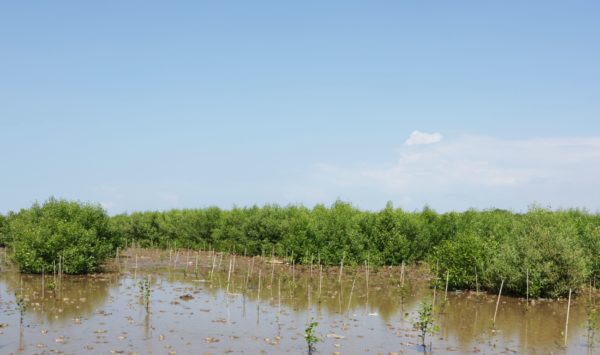
A Trees4Trees mangrove project planted in 2021


Photo: Trees4Trees/Yulianisa Dessenita

How can we combat global warming? Planting trees is a good place to start. Forests are the lungs of our planet. They produce oxygen and absorb the emissions we produce, while also keeping potentially harmful carbon in the ground, where it belongs. 

But when you think of forests, you probably don’t think of coastal and marine ecosystems, right? And yet, these ecosystems store more carbon than anywhere else on Earth. Carbon absorbed and stored here is called “blue carbon”. And blue carbon could be the key to a greener future.  

What is blue carbon and why is it important? 

Blue carbon is the carbon stored in coastal and marine ecosystems. Most of it is carbon dioxide (CO2) that has dissolved directly into the ocean. Lots of blue carbon is stored in underwater sediment, coastal vegetation, and coastal soils. 

Coastal ecosystems can be sea grasses, mangroves, and salt marshes. They all play a crucial role in capturing and retaining carbon. It is for this reason that they’re sometimes called ‘carbon sinks. Although coastal ecosystems are smaller than terrestrial forests, they actually  sequester and store more carbon. 

Unlike in tropical forests, where carbon is stored in above-ground plants, blue carbon is stored below the ground., Some blue carbon can be thousands of years old.  

Did you know? Coastal ecosystems store more carbon per hectare than terrestrial forests. 
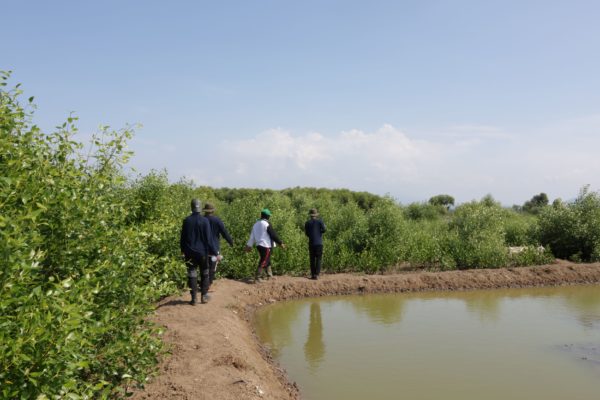
A Trees4Trees mangrove project planted in 2021
(Above) A Trees4Trees mangrove project planted in 2021. Photo: Trees4Trees/Yulianisa Dessenita

Coastal ecosystems: Our first line of defense 

Every year, mangroves and coastal wetlands suck ten times more carbon out of the atmosphere than tropical forests. They also store three to five times more carbon.  

When these habitats are damaged or destroyed, all that carbon is released into the atmosphere as harmful greenhouse gases. This makes protecting and restoring coastal habitats essential to combating climate change.  

Healthy coastal ecosystems give us loads of other benefits besides carbon. They offer protection from storms and erosion, provide nurseries for commercial fisheries, and are beautiful places for us to explore and enjoy. 

Did you know? Coastal habitats make up less than 2% of total ocean area, but store around 50% of the carbon sequestered in ocean sediments 
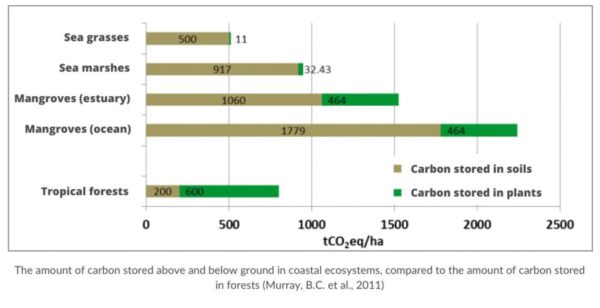
Carbon stored in mangroves ecosystem comparation
The graphic is modified from the original source IUCN

Coastal ecosystems in Indonesia 

In case you didn’t know, Indonesia is huge. This enormous archipelago is home to nearly a quarter of the world’s mangroves, which cover about 3.2 million hectares.

Together with 3 million hectares of sea grasses, these areas store about 3.4 billion metric tons of carbon – that’s 17% of all the blue carbon in the world. 

But despite their massive importance, Indonesian mangroves are under serious threat. Every year, more of these areas are converted into ponds or swallowed up by urban expansion. 

Indonesia emits 190 million tons of CO2-eq every year. That’s 42% of the world’s annual emissions from the destruction of coastal ecosystem services. 

Read more: Five types of mangrove in Indonesia and their benefits 

Trees4Trees mangrove restoration program  

As part of our commitment to support the Indonesian government’s efforts to restore mangrove cover and preserve blue carbon stored in coastal ecosystems, Trees4Trees has been busy replanting mangroves in Central Java. 
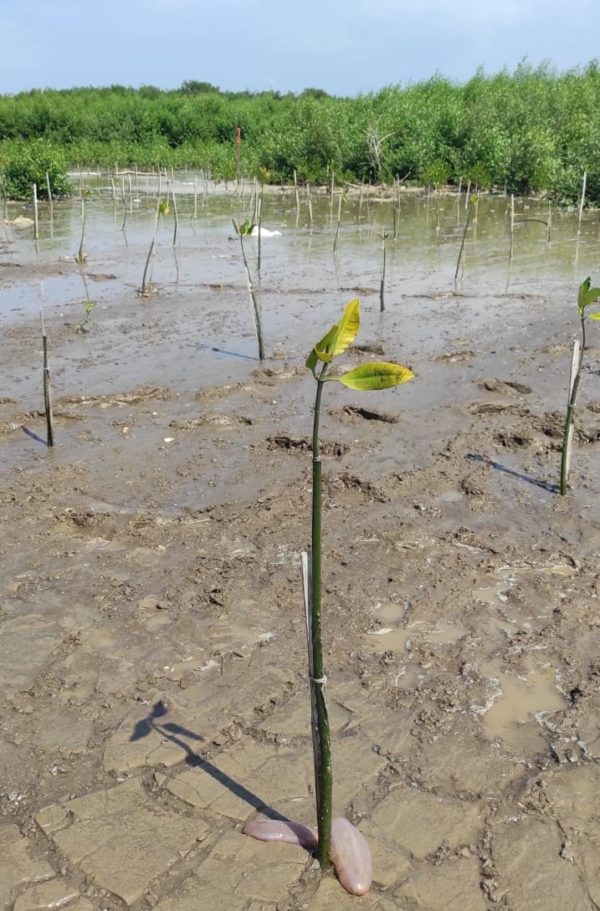
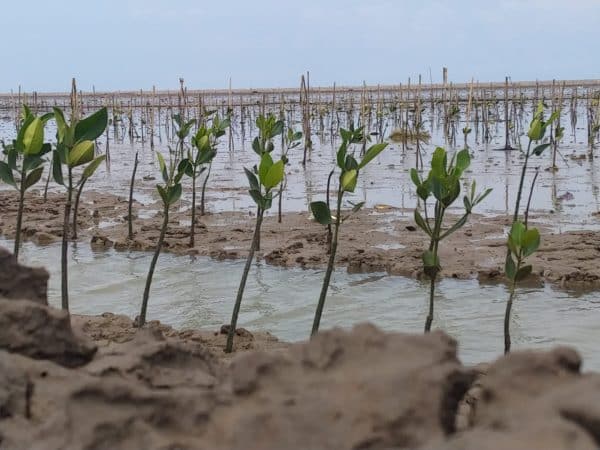
A sea cucumber and mangrove seedling in Dukuhseti coastal area, Pati.
(Above) A sea cucumber and mangrove seedling. Photo: Trees4Trees/V. Arnila Wulandani

“From 2021 to 2022, we successfully planted more than 100,000 seedlings in seven coastal villages in Pati,” explains Khoirum Minan, Trees4Trees Pati Unit Manager. “We aim to prevent tidal surges that can erode shorelines and pose a threat to residential areas and fishponds owned by local communities,” he added

The benefits of Trees4Trees mangrove planting mission in Central Java can already be clearly seen. “Mangroves we planted in 2021 have formed a green belt,” says Mustofa, the farmer group leader in Dukuhseti village in Pati. The ecosystem has taken shape, and we often observe birds, fish, and crustaceans in these newly restored mangrove areas.”  

Did you know? It’s estimated that 83% of the global carbon cycle is circulated through the ocean. 

Elsewhere in Central Java, Trees4Trees recently planted 7,600 plants in an area of mangroves spanning 2.4 hectares in Segara Anakan, Cilacap., This previously degraded mangrove ecosystem is now thriving.  

This small-scale pilot project was a chance for us to try out our planting methods before the time came to tackle a bigger challenge. And that time has now arrived.  By 2027, Trees4Trees aims to plant 3.5 million trees in an area covering 1,000 ha in Cilacap, Central Java. 

Read more: Replanting mangroves rebuilding future in Central Java 

“Our project aims to restore the degraded mangrove ecosystems, enhance mangrove species diversity, promote fish populations and biodiversity, and eliminate invasive weeds that disrupt the mangrove growth,.” says Armin Mubarok, the Trees4Trees Impact Officer leading the mangrove planting program in Cilacap. 
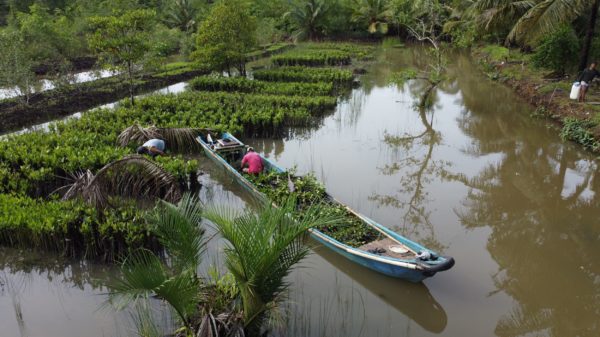
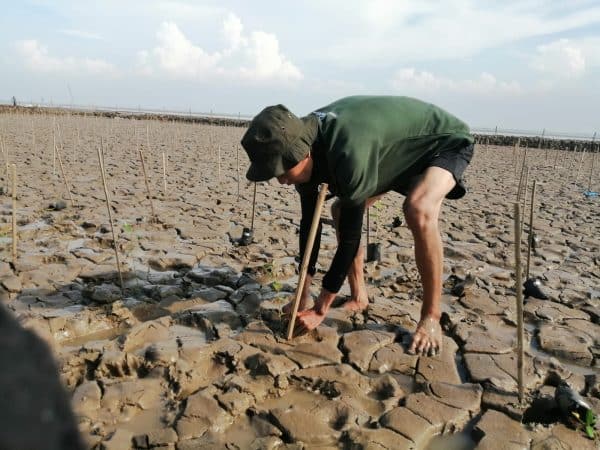
Mangrove planting in Cilacap
(Above) Mangrove planting in Cilacap. Photo: Trees4Trees/Haryadi

Through our mangrove planting efforts, Trees4Trees is working to restore degraded mangrove ecosystems and build new green belts along Indonesia’s precious coastlines.  

Together with our local partners, we’re working to preserve blue carbon, and provide lasting benefits to people and nature.  

Writer: V. Arnila Wulandani. Editor: Christopher Alexander

The Incredible Benefits of Mangroves Ecosystem

world mangrove day

world mangrove day

When you walk along the beach, have you ever seen trees which grow in the seawater? Those are mangrove trees. They are a type of tree that can tolerate saltwater. Mangroves can be found along the shores, rivers, and coastlines in tropical and subtropical countries around the world.  

Indonesia itself is a home for one of the largest mangrove populations in the world. The mangrove cover in Indonesia is estimated to be 3,2 million hectares or 22,4 percent of the total mangroves’ population in the world. So, when you travel to Indonesia, mangroves can be found on almost every one of the 17,000 islands.  

The mangrove ecosystem is commemorated internationally on 26 July every year as the International Day for the Conservation of the Mangrove Ecosystem or World Mangrove Day. This day marks the importance of mangrove ecosystems for the wellbeing, food security, protection of coastal communities, and mitigating climate crisis.  

The ecosystem affords significant contributions for nature and human beings. It is not only incredibly effective in sequestering carbon, stabilizing climate, and combating climate crisis, but also supporting coastal communities’ livelihood and biodiversity.  

Here are some remarkable benefits of mangroves we need to know and why we should protect and restore this species.  

Mangroves are A Very Important Carbon Sink 

Compared with other terrestrial forests, mangroves absorb vast amounts of carbon. Mangrove forests can store five times more carbon than a typical tropical forest. One-hectare mangroves can store up to 3.700 tons of carbon, which is equivalent to taking more than 2.650 cars off the road for a year.  

Mangroves are effectively absorbing greenhouse gases from the atmosphere and mitigating the effects of climate change.  

Mitigate Coral Bleaching 

Coral bleaching is one of the devastating effects of climate change which causes coral to lose its color and turn white. When coral bleaching occurs, it disturbs the ocean ecosystem and can cause the death of entire coral reefs. Healthy mangrove forests can provide shelter for some coral species which are at risk. Mangrove forest also can reduce ocean acidification that can harm marine species such as mollusks, corals, and some varieties of plankton which are all important links in the worldwide food chain. 

Hotspot of Biodiversity and Nursery Ground 

Mangroves provide a home, nursery, and feeding ground for a wide range of animals, including fishes, birds, insects, reptiles, mammals, and various crustaceans like shrimps and crabs. Mangrove areas are also supplying organic and inorganic nutrients that are important for the species. In other words, mangroves are hotspots of biodiversity and form a healthy and rich ecosystem.  

Defense Against Floods, Waves, and Reduce Erosion 

Mangrove forests are effective in reducing strong wind and waves which pass through. They also act as a powerful coastal defense against storms, hurricanes, reducing the high waves and destructive tidal surge. The dense roots of mangroves are capable of binding and building soil which can slow down water flows and reduce erosion. 

Supporting Well-being and Livelihood for Coastal Communities 

Mangroves provide benefits for millions of people who live close to coastal areas with mangrove forests. Many of them rely on mangroves for food, wood, tourism, and enhance fishery productivity. 

Some mangroves’ species bear fruit which can be processed into flour, snacks, and other foods. Mangroves are also habitat for fishes and various crustaceans like shrimps and crabs which provide daily food and income for local communities.   

World mangrove day

Mangroves accommodate incredible benefits and impacts for nature and human beings. Sadly, mangroves have experienced loss and degradation worldwide, declining 30 to 50 percent in the past 50 years. In Indonesia mangrove forests are also in a significant level of degradation. About 52 thousand hectares of mangrove forests in Indonesia are lost every year.

Read also: Mangrove Planting Program with EcoMatcher Inspires Villagers to Plant More Mangrove Trees

In 2021, Trees4Trees planted 36.000 mangroves in 3.8-hectare mangrove as a pilot project in Pati, Central Java. In 2022 Trees4Trees will plant 100,000 more mangrove trees in this area. 

The loss of mangrove cover will bring serious negative impacts not only ecologically but also economically. Therefore, protecting and conserving mangrove ecosystems needs our collective efforts. You can also contribute to planting mangrove trees with us. Contact us to find out how to get involved! 

Happy International Day for the Conservation of the Mangrove Ecosystem! 

Author: V. Arnila Wulandani