One Woman’s Story: Ratiyem the Farmer and Devoted Housewife

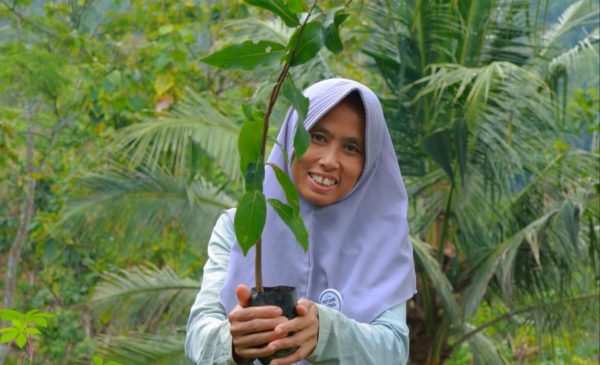
In Indonesia, social convention often dictates that a women’s place is in the home. But Ratiyem doesn’t care about convention. This 46-year-old farmer from Gunungsari Village in Kebumen, Central Java believes women have a right to work and follow their dreams. During her life, she has taken a long, hard road to independence. 

Nothing ever came easy for Ratiyem. Trapped in a cycle of poverty from an early age, her education was cut short when her family couldn’t pay the school fees. Ever since then, she’s been working hard to make ends meet. As a teenager, she took a job as a housemaid in Semarang, 170 kilometers away from her home and family.  

She worked hard in the big city for more than 10 years, but always felt like it wasn’t where she was meant to be. “I liked working in Semarang, because I could make a living,” explains Ratiyem. “But if I kept working there, there would be no-one to take care of my kids and my husband. I knew I had to return to my village,” she added.  

A woman’s work is never done 

After returning to her village, Ratiyem was determined to provide for her children with the education she never had. Together with her husband, she put her time, her heart and soul into working the soil. 

“I had a field measuring about 500 sqm and thought I could make some money by planting cassava and taro, as they’re always in high demand,” she explains. “My happiest moment as a farmer came when harvesting that first crop and the price was good. It made all the effort worthwhile.” 

Ratiyem balances her work as a farmer with her role as a mother and member of her community. “Early in the morning, after taking care of breakfast and getting the kids ready for school, I walk around the village to collect grass for my cattle. Then, I tend to my field and nurture the growing plants.” 
Growing stronger through the tree-planting program 

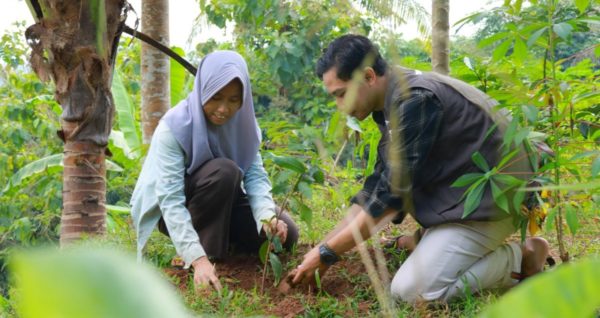
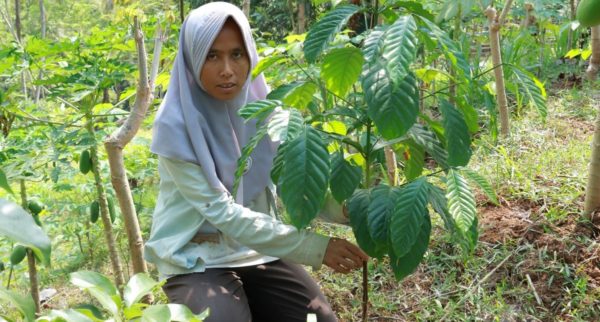
In 2022, Ratiyem was contacted by Trees4Trees, who invited her to become a grower for a tree-planting program in collaboration with Hong Kong – based TREE Ltd. Through this program, she received free seedlings and organic fertilizer, and was able to develop her farming skills with access to new knowledge.  

“I received 200 trees, including sengon, suren, and coffee,” remembers Ratiyem, who believes her own personal development will soon be reflected in the growth of her crops and the increased income it brings. “Being part of this program has provided me with a wealth of new farming knowledge through training, especially organic farming methods. This knowledge has made a big difference, as it guides farmers like me in managing our fields more effectively,” she added. 
The importance of independence 

Ratiyem takes great pleasure in being close to nature, living off the land she was born in. “Unlike the big city, where I had to buy all my food, here my fields provide me with everything I need,” she says, before adding that in her role as farmer she also has a responsibility to support food security. 

Through the Trees4Trees program, Ratiyem hopes to provide food for her community and earn extra income to support her family. Looking to the future, she wants to put more food on more tables, by starting up a catering business with ingredients sourced directly from her field. 
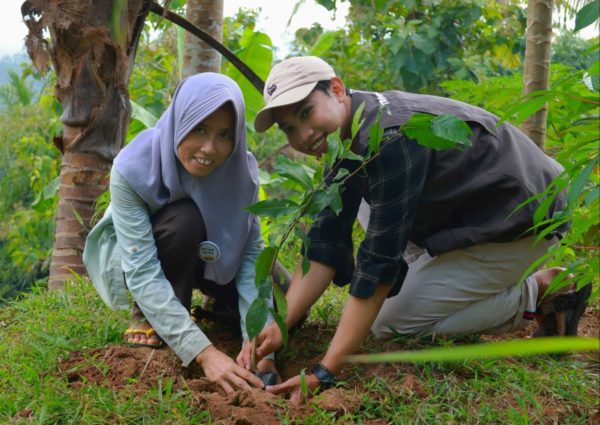
“I want to continue working and being productive,” she explains. “To me, it’s vital for women to work and generate income, so we don’t just rely on men to meet daily expenses. As working women, we can play a role in supporting the family financially,” she added. 

For Ratiyem and the many women farmers like her, independence means more than just following your own path. It is about overcoming obstacles, leading by example, and doing whatever it takes to provide for those who rely on you. With support from Trees4Trees, inspirational women like Ratiyem will continue to be a source of pride to their families and leaders in their communities. 

Writer: V. Arnila Wulandani. Photo: Yulianisa Dessenita

Rasito, Optimizing His Field with Coffee Trees

Rasito were proud of the sengon trees he grows. They reach more than 10-meters in height now.

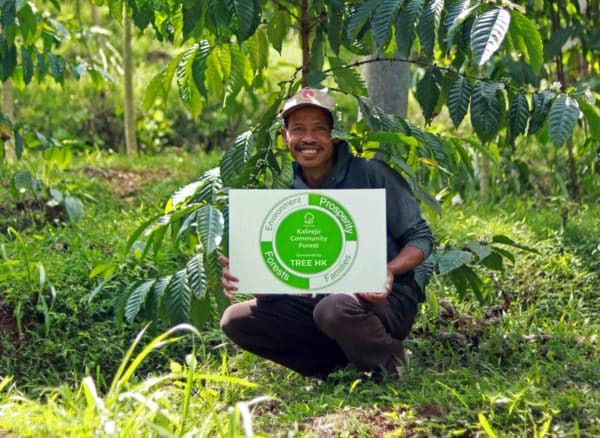
In 2019, Rasito (53) joined the tree planting program initiated by Trees4Trees and Tree Ltd. At that time, he proposed various types of tree seedlings such as sengon, indigofera, and coffee to be planted in his field. He cannot help but feel grateful for the free seedlings he received. His decision to register and join the tree planting program three years ago was actually because of his strong will to optimize the yield of the field he owned. 

Fortunately, Rasito has a more fertile field compared to the fields in other villages. His field is located not far from his home in Kalirejo Village, Kebumen Regency.    

“I can say my field is fertile and easy to plant with any kind of crops and timbers. I think it is because the location is near the spring and river. So, when the dry season comes, it does not ever experience a drought,” Rasito said.  

Manage Pests is the Biggest Challenge

While strolling around his field, he seemed to trim the yellow leaves occasionally. According to Rasito, the biggest challenge to manage plants in his field is because of pests. “These yellow pests are very troublesome. They make leaves turn yellow, wilt, then die. Many sengon trees from Trees4Trees that I planted here were attacked by this kind of pest and could not survive. Auspiciously, there are still around 20 sengon trees that survive and grow well,” Rasito continued. He was pointing us to the sengon trees which now have reached 10 meters in height.  

Rasito, Optimizing His Field with Coffee Trees
Rasito thanks Trees4Trees and Tree HK for providing him various kinds of tree seedling, including coffee.

Since returning to his village twenty years ago, Rasito has chosen to focus on agriculture. He used to work in the coffee plantation in Lampung, Sumatera. However, he decided to return to his village because his heart felt heavy to leave his 7-years old son at that time. 

From the coffee plantation he used to work at previously, he has learnt a lot about agriculture and how to grow coffee. From his parents, he inherited traditional agriculture knowledge. He used them to manage his field area of more than 1.000 square meters until now.  

Unsatisfied with The Result of His Field

Before joining the tree planting program, most of his field was planted with cassava and taro. There were also turmeric and Kaempferia galanga or aromatic ginger. He also planted stinky beans, papaya, and kelor trees. All the yields to be sold as his income to support his family’s daily needs. He also raised goats as his saving.  

Regrettably, the price of cassava as his main yield is less competitive in the market. “One kilogram of cassava that has been cleaned costs around 1.700 rupiahs. If I don’t clean the skin, the price is only 1.500 rupiahs per kilogram. Taro’s price is much better. It is more stable, around 2.000 rupiahs per kilogram,” Rasito revealed. When the price drops or does not sell well in the market, then Rasito must give up the cassava he grew to be used as his cattle’s feed.  

For that reason, when he heard that there was a tree planting program and free seedlings distribution, he was enthusiastic. “At that time, I heard that coffee seedlings would be distributed to farmers. I was interested. I always want to apply the knowledge I have learned from the coffee plantation where once I worked in my own field,” told Rasito. 

Rasito, Optimizing His Field with Coffee Trees
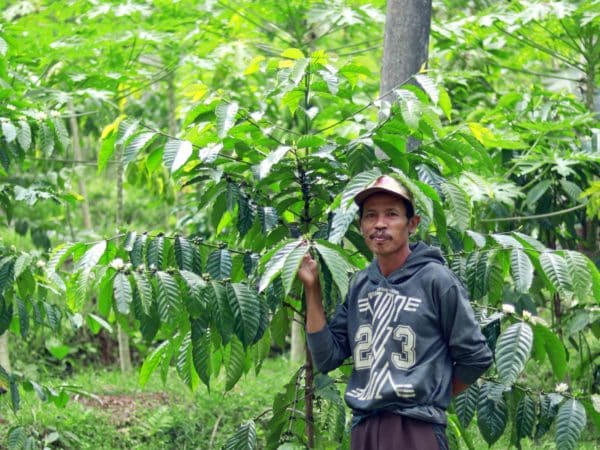
Rasito with Robusta coffee trees that he has grown since 2019.

Growing Coffee Trees, Increasing His Field’s Productivity

He was thrilled to know that of the 180 Robusta coffee seedlings he received in 2019, he managed to grow well 150 coffee trees. Over the last three years, he has already harvested twice. “In one harvesting time, there may be about 5 kilograms. But it has not been sold yet. I am still testing my coffee trees, grinding the beans, and consuming them by myself. I have compared the taste with the Robusta coffee sold in the market and even with coffee sold in a cafe. I am sure that this coffee can compete with them,” he said confidently.  

Compared with cassava, Rasito believes coffee is more prospective. He also said it is not difficult to grow coffee trees. According to his survey, ground Robusta coffee’s price in the market can reach 30.000 rupiahs per kilogram. That interested him. Therefore, Rasito intends to replace cassava and taro with coffee in the future. “These cassavas are temporary. When I can grow more coffee trees, I will replace all of cassava and taro with coffee in order to make my field more productive as well as my income,” he was hoping.  

In addition to coffee, Rasito also grows pepper which is planted as vines on other trees. He is quite satisfied with the result of pepper. He can sell them for 80,000 rupiahs per kilogram.  

Rasito expects he we will be allowed to join the next tree planting program with Trees4Trees. He hopes he can receive durian and avocado seedlings. “I have tried planting durian and it is growing well in my field. If there will be another program, I intend to apply durian seedlings as well as avocado,” said Rasito. 

Writer: V. Arnila Wulandani. Photo: Yulianisa Dessenita