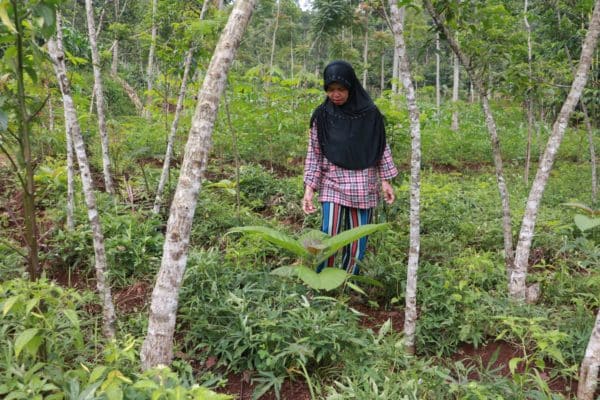
Eco-Friendly Farming: Cicalengka Farmers Move Beyond Timber Logging

Eco-Friendly Farming

For farmers in Nagrog Village, Cicalengka District, West Java, farming is not just a job that fulfills their daily lives, but a cultural heritage passed down through generations. Most of them inherit family land, which they manage by growing crops and trees. They harvest and sell their yield, providing them with a decent livelihood.  

Traditionally, crops like chili, banana, citronella grass, clove buds, and some vegetables formed their primary harvests. They also cultivated trees like burflower (jabon), gmelina, and albizia (sengon), earning income by logging and selling the timbers. However, in recent years, many of them have recognized the need to adopt more environmentally friendly practices to secure their livelihood for the future. 
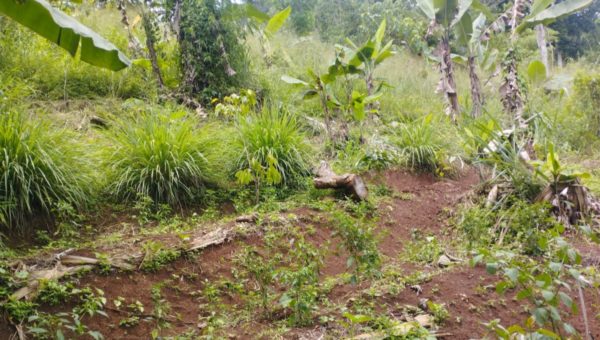
Trees
Crops like citronella grass, bananas, and vegetables are typical crops planted in farmers’ lands.

From Harvesting Timber to a New Eco-Friendly Farming Model 

“Logging trees for timber is an outdated way to earn income,” said Faisal, one of Nagrog Village’s farmers. “For us, cutting down the trees and selling the timber is a thing of the past. We’re transitioning to a farming model focused on growing trees without cutting them down. Tree cover is essential for preventing erosion and controlling rainwater runoff in our village,” he explained.  

In recent years, the farmers in Nagrog Village have united to create a greener future. As an initial step, they have shifted their focus to cultivating more trees and crops, prioritizing the sustainable harvest of fruits and leaves over cutting timber.
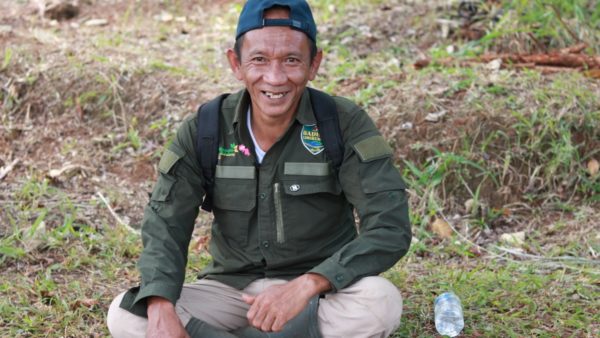
Eco-Friendly Farming
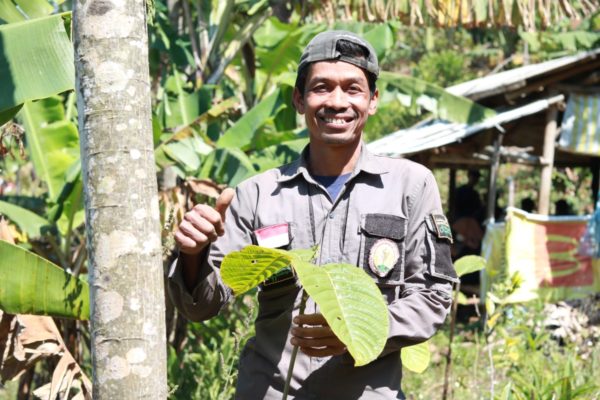
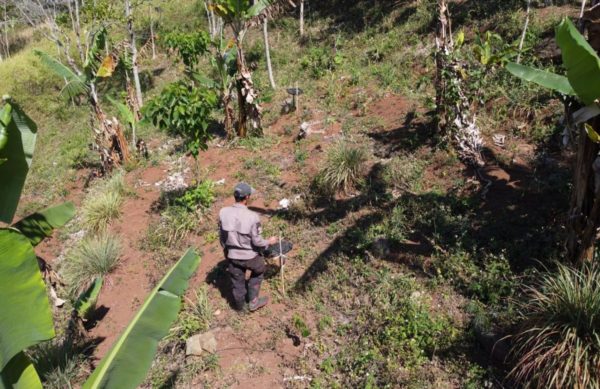
Faizal took a rest after working on his land in Nagrog Village

Maximizing Cloves and Citronella Grass 

Clove trees and citronella grass are the main crops they cultivate lately. “Clove buds fetch a good price in the market. It’s 80,000 rupiah per kilogram,” shared Agus, another farmer. “Citronella grass grows exceptionally in our village land, with consistent demand and good prices as it’s used for essential oils,” he added. Agus also noted Arabica coffee’s potential, priced between 15,000 and 18,000 rupiah per kilogram, although market fluctuations are a challenge. “So, we need to diversify crops and fruit trees to stabilize our income,” he emphasized.  

On the other hand, Yaya, another farmer, faces different challenges when growing cloves due to his open land exposed with direct sunlight. “The dry season has always been tough, especially last year. Many of my young clove trees didn’t survive the heat. My crops also struggled,” he said. “I’ve used shading nets, but I think more shade trees are needed to reduce the heat and improve their survival rate,” he said. 
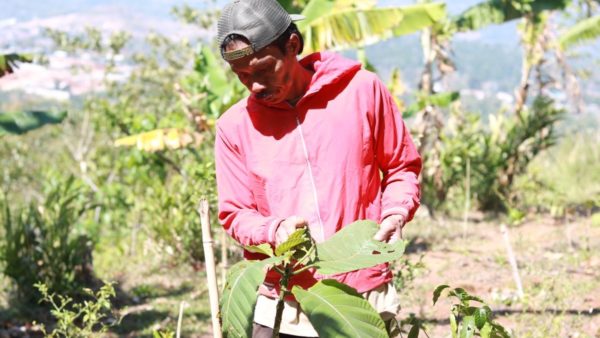
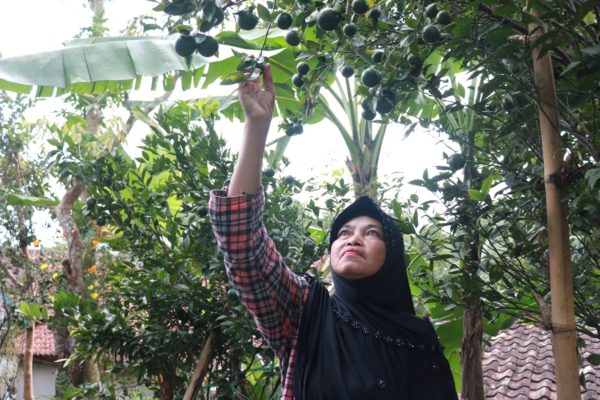
Agus is taking care of burflower trees he planted, ensuring they grow healthy.

Tree Growers

Greener Future with Tree Planting Support 

In 2022, new hope arrived for the green initiatives taken by farmers in Nagrog Village. EcoMatcher, in collaboration with Trees4Trees introduced a tree planting program that engaged local farmers as tree grower partners. Among the participants were Faizal, Agus, and Yaya, who benefited from the program.  

“I received over 400 tree seedlings of clove and burflowers trees. This really helped me since I can’t afford them on my own,” said Yaya. He considered cloves to enhance the existing trees he planted, and burflowers to provide shade for his sun-scorched land.  
Eco-Friendly Farming
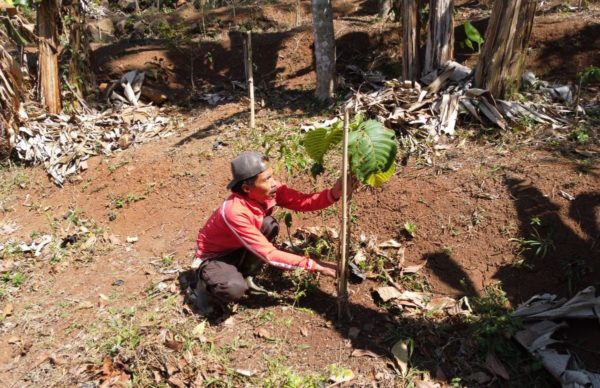
Yaya is working on his land, where he implemented agroforestry by combining crops and trees.

Faisal highlighted how the program supports farmers in multiple ways, not only providing free seedlings but also advanced farming knowledge. It includes teaching farmers with agroforestry technique to optimize results both income and environmental health.  

“We planted burflower trees to provide shade for our crops. Citronella grasses were planted on sloped lands to prevent erosion, and clove trees were added to our existing stock, offering valuable buds in six years while benefiting the environment. We’re truly grateful for this program,” Faisal said. 

Cultivating Hope for the Future  

With increased tree cover supporting their green initiatives, farmers are now exploring further innovations. “Clove trees offer benefits beyond the buds; their leaves can be used for essential oil production. We’re also looking into enhancing income from citronella grasses by producing essential oils ourselves, because the demand is high, and the market is competitive,” said Faisal. 

However, a lack of production machinery and knowledge remains a challenge for them. Despite this, they remain hopeful about realizing their dream. “With more trees planted, we believe doors open to further improvements in our sustainable farming practices,” added Faisal. 

In line with Faisal, Agus expressed his commitment to working with fellow farmers in his village to implement environmentally friendly farming practices. “I’m no longer interested in logging trees for timber. By preserving trees, we protect the environment and safeguard our village’s water sources for our community’s lasting survival. I think that is the most important thing,” he said. 

Writer: V. Arnila Wulandani. Photo: Kemas Duga Muis

The Story of Euis Maryati: Widowed and Planting Trees to Support Her Family

Euis Maryati
Euis Maryati: Widowed and Planting Trees to Support Her Family

For a woman with four children, it is never easy being a single parent. This is how Euis Maryati (57) feels. She is one of the farmers in Patrolsari Village, Arjasari District. Since a few years ago, she had to be a mother and also head of the family.

As a widower, her life is struggling. Even though, she keeps herself motivated to be a strong woman for the sake of her family. Unlike common life of most women in her village, her daily life is not only about taking care of the household things, but also making income to fulfill her family’s needs. Otherwise, she has to work harder than anyone else. 

Farming Crops is not Enough to Fulfill Her Family’s Daily Needs

Fortunately, Euis Maryati has a field that she can plant many kinds of plants. Most of them are seasonal food crops. Through her field, she can depend her life to the crops’ yield. “Here, I planted various kind of food crops. I planted chilies, cassava, ground nuts, and red bean. There is also corn. Usually, I harvest my seasonal crops once in every two to three months,” said Euis Maryati.  

Afterwards, she sells her crops in a traditional market around her village. Some of the crops are also self-consumed by her family. According to Euis Maryati, by planting crops, at least she does not have to worry if some days she does not have enough money to buy food. Still, she can pick some food crops from her field for her own family consumption.  

Euis Maryati: Widowed and Planting Trees to Support Her Family
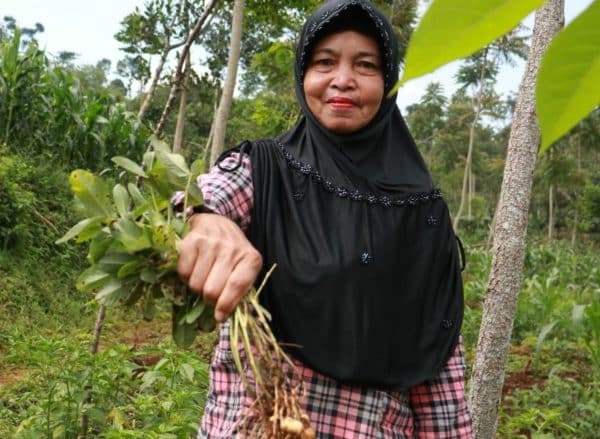
Euis Maryati has harvested crops from her field. Photo: Trees4Trees/Kemas Duga Muis

Even though, to meet her family’s daily needs, she cannot avoid doing double jobs at one time. Besides farming, she also sells snacks. “If I do not farm, I cannot support my family’s needs. However, farming crops is not enough. So, I have also opened a small business selling snacks. It is to increase my income to meet my family’s daily needs,” she conveyed. 

Planting Trees: Cultivating a Better Future for Her Family

In 2021, when she was offered a partnership program of tree planting funded by Astra Zeneca collaborated with Trees4Trees and One Tree Planted, Euis Maryati planted burflower-tree, avocado, mango, and orange. She planted those trees among her seasonal crops in her field. She admitted that she was lucky to get plants from the tree planting program. She hopes a lot from trees she planted for the future of her family. 

She has been persevering in taking care of her trees. She cleans the grass every day so that all the plants grow well. She also applies her plants with organic fertilizer that she made herself from animal dung. 

Euis Maryati: Widowed and Planting Trees to Support Her Family
Euis Maryati is checking her jabon trees planted in her field along with various crops.

She expects, by taking good care of those trees, she will be able to harvest the good results. Moreover, now plants in her field are more varied. With more types of trees planted, she hopes she can sell more yields in the future, then she can fulfil her family’s needs much better than today. 

“My life has been difficult for years. So I am hoping that it does not get any harder. If not myself, who else will  support my family? I realize that I am both the mother and the head of the family. It is not easy. But for my children and their future, I will continue to work harder,” she stated.  

She thanks to the tree planting program and she hopes it can bring more prosperity and a better future for women farmers and single parents like her. 


Rasito, Optimizing His Field with Coffee Trees

Rasito were proud of the sengon trees he grows. They reach more than 10-meters in height now.

In 2019, Rasito (53) joined the tree planting program initiated by Trees4Trees and Tree Ltd. At that time, he proposed various types of tree seedlings such as sengon, indigofera, and coffee to be planted in his field. He cannot help but feel grateful for the free seedlings he received. His decision to register and join the tree planting program three years ago was actually because of his strong will to optimize the yield of the field he owned. 

Fortunately, Rasito has a more fertile field compared to the fields in other villages. His field is located not far from his home in Kalirejo Village, Kebumen Regency.    

“I can say my field is fertile and easy to plant with any kind of crops and timbers. I think it is because the location is near the spring and river. So, when the dry season comes, it does not ever experience a drought,” Rasito said.  

Manage Pests is the Biggest Challenge

While strolling around his field, he seemed to trim the yellow leaves occasionally. According to Rasito, the biggest challenge to manage plants in his field is because of pests. “These yellow pests are very troublesome. They make leaves turn yellow, wilt, then die. Many sengon trees from Trees4Trees that I planted here were attacked by this kind of pest and could not survive. Auspiciously, there are still around 20 sengon trees that survive and grow well,” Rasito continued. He was pointing us to the sengon trees which now have reached 10 meters in height.  

Rasito, Optimizing His Field with Coffee Trees
Rasito thanks Trees4Trees and Tree HK for providing him various kinds of tree seedling, including coffee.

Since returning to his village twenty years ago, Rasito has chosen to focus on agriculture. He used to work in the coffee plantation in Lampung, Sumatera. However, he decided to return to his village because his heart felt heavy to leave his 7-years old son at that time. 

From the coffee plantation he used to work at previously, he has learnt a lot about agriculture and how to grow coffee. From his parents, he inherited traditional agriculture knowledge. He used them to manage his field area of more than 1.000 square meters until now.  

Unsatisfied with The Result of His Field

Before joining the tree planting program, most of his field was planted with cassava and taro. There were also turmeric and Kaempferia galanga or aromatic ginger. He also planted stinky beans, papaya, and kelor trees. All the yields to be sold as his income to support his family’s daily needs. He also raised goats as his saving.  

Regrettably, the price of cassava as his main yield is less competitive in the market. “One kilogram of cassava that has been cleaned costs around 1.700 rupiahs. If I don’t clean the skin, the price is only 1.500 rupiahs per kilogram. Taro’s price is much better. It is more stable, around 2.000 rupiahs per kilogram,” Rasito revealed. When the price drops or does not sell well in the market, then Rasito must give up the cassava he grew to be used as his cattle’s feed.  

For that reason, when he heard that there was a tree planting program and free seedlings distribution, he was enthusiastic. “At that time, I heard that coffee seedlings would be distributed to farmers. I was interested. I always want to apply the knowledge I have learned from the coffee plantation where once I worked in my own field,” told Rasito. 

Rasito, Optimizing His Field with Coffee Trees
Rasito with Robusta coffee trees that he has grown since 2019.

Growing Coffee Trees, Increasing His Field’s Productivity

He was thrilled to know that of the 180 Robusta coffee seedlings he received in 2019, he managed to grow well 150 coffee trees. Over the last three years, he has already harvested twice. “In one harvesting time, there may be about 5 kilograms. But it has not been sold yet. I am still testing my coffee trees, grinding the beans, and consuming them by myself. I have compared the taste with the Robusta coffee sold in the market and even with coffee sold in a cafe. I am sure that this coffee can compete with them,” he said confidently.  

Compared with cassava, Rasito believes coffee is more prospective. He also said it is not difficult to grow coffee trees. According to his survey, ground Robusta coffee’s price in the market can reach 30.000 rupiahs per kilogram. That interested him. Therefore, Rasito intends to replace cassava and taro with coffee in the future. “These cassavas are temporary. When I can grow more coffee trees, I will replace all of cassava and taro with coffee in order to make my field more productive as well as my income,” he was hoping.  

In addition to coffee, Rasito also grows pepper which is planted as vines on other trees. He is quite satisfied with the result of pepper. He can sell them for 80,000 rupiahs per kilogram.  

Rasito expects he we will be allowed to join the next tree planting program with Trees4Trees. He hopes he can receive durian and avocado seedlings. “I have tried planting durian and it is growing well in my field. If there will be another program, I intend to apply durian seedlings as well as avocado,” said Rasito.