Taking the Next Step: Trees4Trees’ Planting Season 2023-2024

Trees4Trees’ Planting Season 2023-2024

Taking the Next Step: Trees4Trees’ Planting Season 2023-2024

At Trees4Trees, we started the new year early, by kicking off our 2023-2024 planting season back in December. With the generous support of our sponsors, volunteers, and donors, we plan to continue these programs through March 2024. 

Since December, millions of seedlings have been distributed from our nurseries to locations all over Java. Each of these trees offers reason for hope. From village to city and from coast to coast, they can help protect the environment and empower local communities.  

Rising to the challenge 

Indonesia saw its fair share of troubles in 2023. An extended dry season, caused by El Niño, delayed our planting efforts by a month – from November to December. Now the rains have finally arrived, were determined to make up for lost time. 

“We intend to plant 4.9 million trees across Java,” says Pandu Budi Wahono, Trees4Trees Program Manager. “This will help around 21,770 local farmers in 231 villages,” he added.

Continuing the Citarum Watershed project  

A big part of this program is our Citarum Watershed restoration project. Our goal, with support from 18,800 local farmers in 176 villages in the watershed area, is to plant 4 million trees in the next couple of months. 

“The restoration covers areas around five sub-watersheds,” explains Tomi Bustomi, who is our Regional Manager for West Java. “Ciminyak, Ciwidey, Cisangkuy, Cirasea, and Citarik River.,”  

Working alongside the Government of Indonesia, Tomi and his team aim to plant 10 million trees by 2025. In doing so, they will help restore ecosystems, preserve cultural and economic value for local communities, and safeguard biodiversity. 
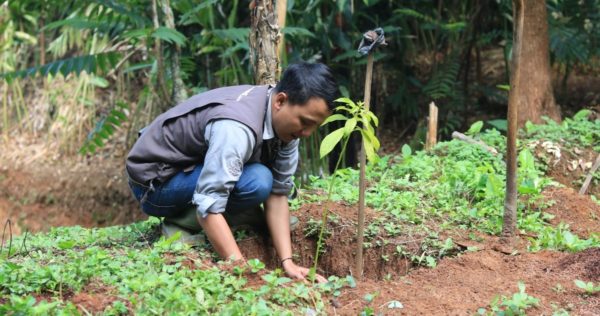
planting Tree

A shore sign of progress: Replanting on the coast of Java 

In Pati Regency in Central Java, Trees4Trees is creating a green belt along the shoreline by planting mangroves. From 2021 through 2023, we already planted a total of 195,200 trees in six villages. Now, the plan is to extend these efforts to four more villages in the region.  

During December and January, a total of 33,750 new trees were planted in the villages of Semerak, Dukuhseti, Tegalombo, and Banyutowo. Khoirum Minan is the Trees4Trees Pati Unit Manager, who says extending the green belt in this way can benefit local communities by “preventing high tides from hitting residential areas and fishponds owned by locals.”  

Saving water, improving lives  

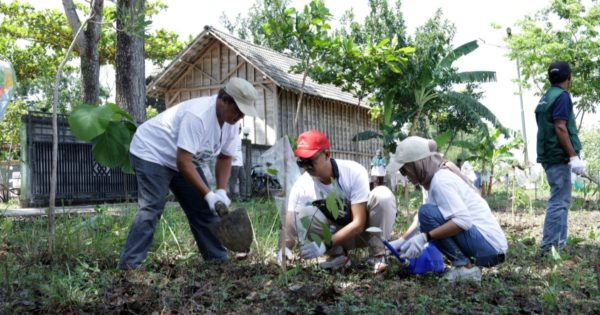
Last year’s prolonged dry season had a massive impact on local communities. Lots of places experienced serious water shortages, which affected both people and plants. To prevent this happening again in the future, Trees4Trees has been busy planting lots of tropical fruit trees known for their ability to store water when times are hard.  

These tree species include teak, kaliandra, and indigofera. We’ve also planted multi-purpose trees like coffee and petai, which are good for the environment and offer a sustainable source of income for local people too. 

Taking the Next Step: Trees4Trees’ Planting Season 2023-2024
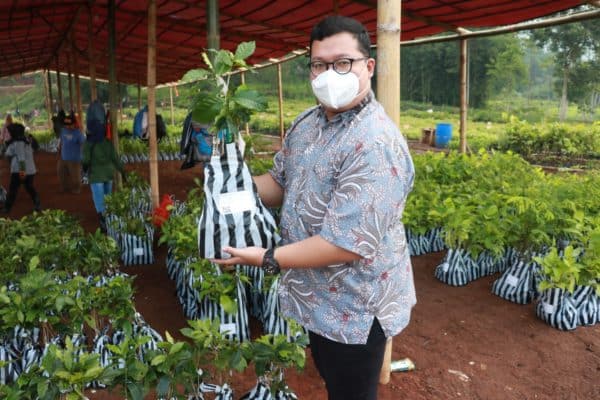
(Above) Water sources in Boyolali dried up in 2023, so T4T stepped  to support water conservation  by planting seedlings that will store water in their trunks, prevent soil erosion, and reduce surface run-off (below).

Distribution process

Expanding urban forests 

Our replanting plan extends to all kinds of environments, tackling a range of problems. This even includes cities and industrial areas, where trees bring some much-needed shade, carbon capture, and soil health, not to mention adding a little natural beauty. 

Most recently, Trees4Trees has been busy planting urban forests in industrial areas like GIIC in Bekasi, KIIC in Karawang, and Bogor. 
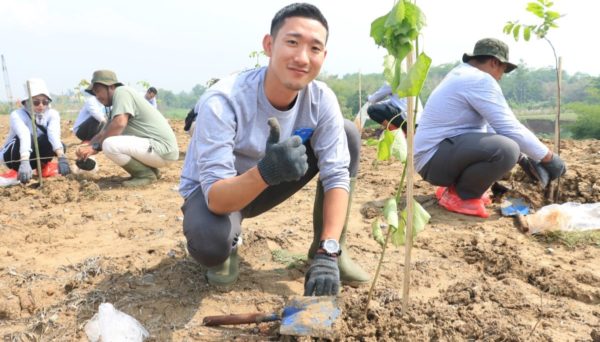
Taking the Next Step: Trees4Trees’ Planting Season 2023-2024
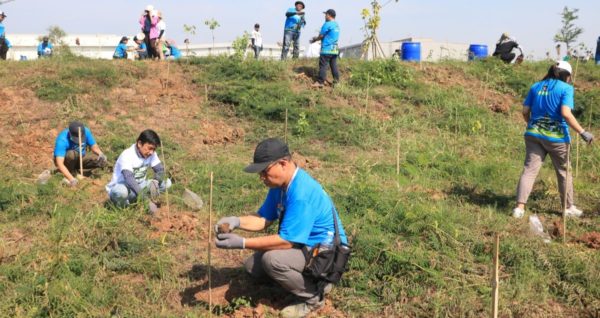
(Above) A recent tree planting event at GIIC Bekasi with Nissin and (Below) with Microsoft in Bekasi.

CSR program

another planting event
(Above) Another planting event, this time with AOI & ITS in Bojonegoro, East Java. (Above) Another planting event, this time with AOI & ITS in Bojonegoro, East Java.

It takes a village: Working together with partners 

In all our replanting operations, we collaborate with lots of different companies and organizations to get the job done. Each of these events helps deliver sustainable impacts to different areas, from cultural and historical sites to industrial regions, villages, farmland, and watersheds.  

Every project is a team effort. By involving staff, partners, and clients as tree-planter volunteers, and teaming them up with local communities of growers and farmers, we’re helping create new networks.  

Whether developing skills, sharing stories, or simply making new friends, the Trees4Trees planting season continues to expand its impact. Everyone involved is ready to take the next step on this journey, together. 


A Watershed Moment: Planting Begins at the Citarum River

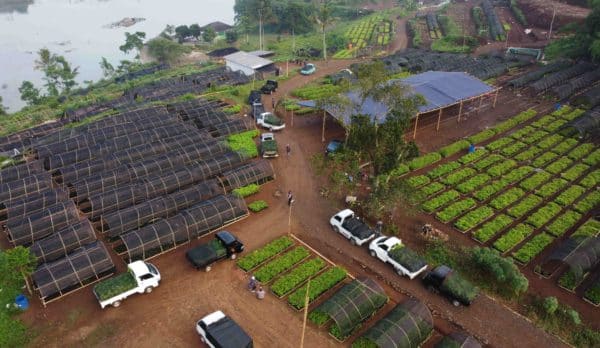
The latest batch of seedlings sets off from Trees4Trees’ new nursery in Ciminyak
Our Ciminyak nursery for Citarum River
(Above) The latest batch of seedlings sets off from Trees4Trees’ new nursery in Ciminyak – part of our program to plant 10 million trees in the Citarum watershed by 2025. Photo: Trees4Trees/Kemas Duga Muis.

In 2018, the Citarum became famous for all the wrong reasons, when an environmental survey and medias reported it as the ‘World’s Dirtiest River’. In response, the Indonesian government decided it was high time to implement a comprehensive renewal program for the region. Now, with the help of Trees4Trees, the Citarum is ready to be reborn.

Working closely with the Government of Indonesia and One Tree Planted, and with funding from AstraZeneca, Trees4Trees has started an ambitious reforestation program in the Citarum watershed. A key part of our 2022 planting season, the project will plant a minimum of 10 million trees by 2025.

But how can trees help clean the world’s dirtiest river? What is being done to tackle the problem? And what is the bigger picture for environmental recovery in the region?  Trees4Trees has the answers.

Five Facts: A Closer Look at the World’s Most Infamous River

  1. The Citarum is the longest river in West Java, stretching 185 miles (297 km)
  2. It runs from Bandung, via Jakarta, to the Java Sea
  3. It provides electricity to most of Java and Bali
  4. Pollution comes from household, livestock, industry, agriculture, and fisheries waste
  5. The river contains dangerously high levels of lead, aluminum, manganese and iron

What are the Impacts of all this Pollution?

Disease flooding and citarum river
On People and On Nature

Studies by Indonesia’s Ministry of Environment and Forestry have revealed that pollution in the Citarum not only affects the river – the damage also extends to the surrounding landscape. This area, known as the Citarum watershed, supports hundreds of thousands of livelihoods.

Restoring the Citarum Watershed

The Citarum watershed covers degraded areas of 77,024 hectares in West Java with various problems like erosion and sedimentation occurring, dry soil, clean water shortages, and more. Over the years, the Indonesian government has been working to restore critically degraded lands in this region, which have been in steady decline.

“The Citarum watershed is a priority area in Indonesia for recovery,” explains Muhammad Silmi, from the West Java Forestry Service. “The collaboration of government with various elements in society is very helpful in accelerating the recovery effort,” he added.

Muhammad Rizki Fauzan from AstraZeneca inspects the latest crop of seedlings at our Ciminyak nursery
Muhammad Simi (right), a West Java Forestry Service representative, at Trees4Trees’ Ciminyak nursery in West Java. Photo: Trees4Trees/Kemas Duga Muis.

Taking a Root-and-Branch Approach to Pollution

So how can trees help with this recovery? In the short term, the reintroduction of forests along the banks of the Citarum River can help to increase water retention and reduce surface runoff during the heavy rains that hit West Java during the monsoon. This can dramatically reduce the amount of trash flowing into the river.

Looking to the future, a sturdy network of tree roots can also help bind soils together, preventing erosion and returning valuable nutrients to the earth. Healthy trees also store carbon, provide shelter for wildlife, and offer livelihood opportunities to local people.

Read also: Putting Down the Roots: Trees4Trees Planting Season 2022 

‘A Green Movement’: The Trees4Trees Planting Program

The cleaning and greening process has already begun. With funding from AstraZeneca, and  support from One Tree Planted, we are engaging more than 38,000 farmers in an area spanning 22,000 hectares of the Citarum watershed. Here, we aim to plant 12 million trees in the next three years, with a minimum of 10 million expected to survive past project completion in 2025.

“Trees4Trees will plant more than 10 million trees in the Citarum Basin by 2025”

Since 2020, we have already planted 1.2 million trees in tributary watersheds such as Ciwidey, Cisangkuy, and Cirasea. By focusing on private land, the program complements similar government schemes already underway in national forests.

“With the (Trees4Trees) program, we can collaborate and involve West Bandung residents to make a green movement for Citarum rehabilitation,” says Sanawinarti, a representative of the West Bandung Regency Environmental Service. “We are really thankful to this program,” she added.

Muhammad Rizki Fauzan from AstraZeneca inspects the latest crop of seedlings at our Ciminyak nursery- Citarum River
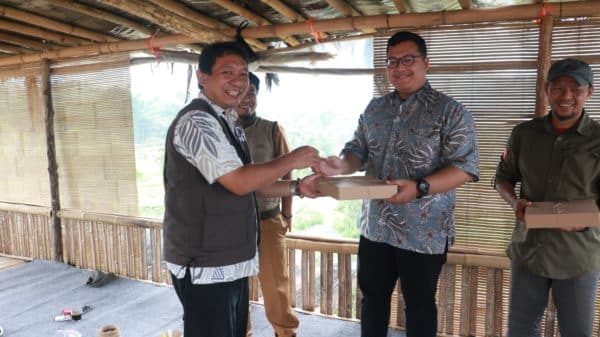
On December 6, Trees4Trees held an opening ceremony for the 2022 planting season at Ciminyak Nursery in West Bandung. The event was attended by representatives from Astra Zeneca Indonesia, the West Java Provincial Forestry Service, the Bandung and West Bandung Regency Environmental Service, and regents (Bupati) representative from both regions. Photo: Trees4Trees/Kemas Duga Muis.

Turning Over a New Leaf: The 2022 Planting Season

On November 24, Trees4Trees kicked off the 2022 planting season in the Citarum river watershed. Since then, more than 1.7 million seedlings have been distributed in the project areas.

In December, we also celebrated the official opening of a new Trees4Trees nursery: the Ciminyak Nursery in Cililin Regency, West Bandung, which became our second nursery in the Bandung area (the other being Arjasari).

Muhammad Rizki Fauzan from AstraZeneca inspects the latest crop of seedlings at our Ciminyak nursery and CItarum River
Muhammad Rizki Fauzan from AstraZeneca inspects the latest crop of seedlings at our Ciminyak nursery. Capable of producing around 2.3 million seedlings per year, the site will play a major role in supporting the Citarum watershed reforestation program. Photo: Trees4Trees/Kemas Duga Muis.

“We hope these seedlings will grow well,” said Muhammad Rizki Fauzan, a representative from AstraZeneca Indonesia in a statement during the opening ceremony. “AstraZeneca also hopes that Trees4Trees will continue collaborating with locals and the Forestry Service in the Citarum rehabilitation effort,” he added.

With the support of local farmers, growers, communities, and government officials, Trees4Trees will continue working to rehabilitate the Citarum watershed. Through collaboration and commitment, we will keep striving to reach our target of 10 million trees by 2025. For now, the future’s looking greener already.


Writer: V. Arnila Wulandani. Editor: Christopher Alexander.